
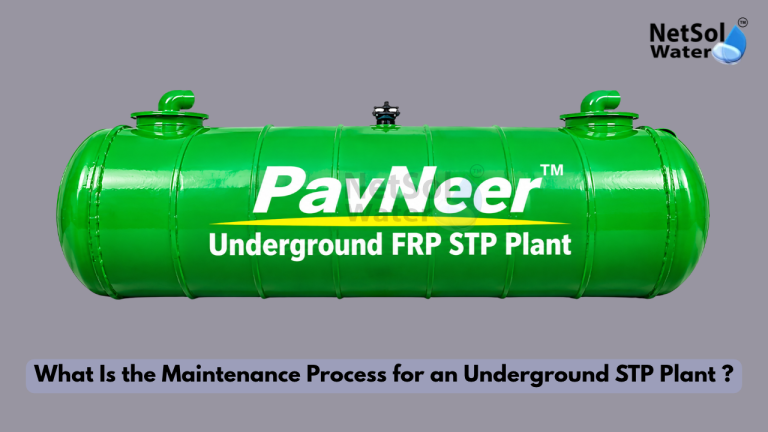
Operation of underground STP involves the same essential operations that apply to all other sewage treatment plants. The difference lies in access and safety considerations. Each operation begins with a safe entry into the underground chambers because the oxygen level could be low and gas could be present. An effective system divides each operation into daily, weekly, monthly, and yearly operations with specific access and readings. In this article we will discuss about what is the maintenance process for an underground stp plant, and how is it done safely.
Why Does Maintenance Need a Different Routine Underground?
An above-ground plant can be inspected at a glance. An Underground Sewage Treatment Plant is inspected through covers, often with the operator leaning over an opening. Equipment must be reached without dismantling the structure. Gas can collect in enclosed chambers, and the air must be checked before anyone enters. The routine has to cover those extra steps as well as the process checks.
What Safety Steps Come Before Any Underground Task?
Safety comes first in all underground operations and not an isolated activity. The following are safety measures which must be observed before any work is carried out:
1) Ventilation of the chamber by opening the cover for a predetermined period before the start of work.
2) Testing the air inside the chamber using a calibrated instrument for oxygen and hydrogen sulphide levels.
3) Not using smell to measure the presence of poisonous gases.
4) The presence of a second person at the surface who can use a line or some means of lifting someone up in case of difficulty.
5) Using barriers to block the open cover and a signboard.
6) Avoiding entry into a chamber alone.
Avoiding entering without testing and planning. If the results of air tests are unfavorable, then the work will be postponed till ventilation and another air test have been done.
What Are the Daily Maintenance Tasks?
Daily checks are short and focused on the plant running safely:
A) Clear the screen basket and note how full it was.
B) Read and record the equalisation tank level at the same time each day.
C) Check the blowers are running, listen for changes in sound, and check the casings for heat.
D) Confirm the dosing pump is running and delivering, and log the chemical level.
E) Check the alarm panel for any active alarm and for any alarm that has been silenced or bypassed.
F) Look at the outlet for colour, clarity, and smell.
Record each reading in the logbook. Anything outside the normal range should trigger a note and a follow-up action that day.
What Are the Weekly Maintenance Tasks?
Weekly tasks cover the parts that need regular attention but not daily checks:
1) Clean the grit channel and remove grit from the chamber.
2) Check the diffuser pattern across the aeration tank. Uneven bubbles suggest fouling or uneven air distribution.
3) Measure dissolved oxygen at two or three points in the aeration tank.
4) Run a settling test on the mixed liquor and record the settled volume after thirty minutes.
5) Check the sludge holding tank level, and note the quantity wasted in the week.
6) Check the chemical use against the previous week, to spot any sudden change.
What Are the Monthly Maintenance Tasks?
Monthly tasks take a little longer and often need a second person at the surface:
A) Inspect the blower intake filters and replace them if they are loaded or damaged.
B) Check the dosing pump calibration and the prime of each dosing line.
C) Inspect the level sensors and floats, and test each alarm.
D) Check the probe calibration, using a reference reading.
E) Review the sample results and compare them with the consent limits and the previous month.
F) Check the ventilation fan and its duct for blockage or damage.
G) Inspect the access covers and their seals for wear, corrosion, or water entry.
What Are the Annual Maintenance Tasks?
Annual tasks need a full inspection and often a shutdown or a planned stop:
1) Inspect the concrete or FRP structure and its joints, penetrations, and waterproofing.
2) Look for cracks, leaks, corrosion, or signs of water entering the chambers.
3) Service the blowers, including bearings, belts, and motor checks, following the manufacturer’s schedule.
4) Clean or replace the diffusers, and check their fixings.
5) Inspect and clean the clarifier or the membrane modules, following the manufacturer’s procedure.
6) Test the standby equipment and the changeover.
7) Review the replacement plan against the running hours and the condition of each component.
How Should You Keep the Records?
Keep a logbook at the plant with the daily and weekly readings, the monthly checks, and the annual inspection findings. Each entry should have the date, the time, the name of the person, the reading or the action, and any follow-up. Keep the sample results, the service visit reports, and the parts replaced in the same file. A complete record shows the plant’s condition over time and is the first thing an inspector or a new operator will ask for.
Who Should Carry Out Which Tasks?
Daily and weekly tasks suit a trained operator on site. Monthly and annual tasks, especially those needing entry into a chamber or the handling of blowers and membranes, suit a service engineer with confined-space training. The operator and the engineer should agree in writing which tasks each one carries out, so nothing falls between them.
What Are the Common Maintenance Mistakes?
A) Skipping the gas test and entering on the strength of a quick look
B) Leaving the screen uncleaned until the pumps trip
C) Ignoring slow changes in dissolved oxygen or settling
D) Letting the sludge holding tank fill beyond its design level
E) Silencing an alarm instead of finding its cause
F) Keeping no records, so the next visit starts from memory
Conclusion
Maintaining an underground STP is a routine built on safe access. Test the air before any entry, follow a daily, weekly, monthly, and annual schedule, assign each task to the right person, and keep a complete record. A plant maintained this way runs more reliably and is safer for the people who look after it.
Commercial RO Plant provides maintenance contracts for underground Sewage Treatment Plants, with confined-space procedures, a task schedule, and a shared logbook set up at handover.Request an underground STP maintenance schedule from Commercial RO Plant or message us on WhatsApp at +91 9650608473.
Suggested internal link: the annual maintenance contract page and the underground STP service page.
Sources:
- CPCB, for the framework on sewage treatment plant operation and monitoring (verify the current document before linking): https://cpcb.nic.in
- Confirm the applicable Indian occupational safety rules for confined-space entry before publishing, and cite the current source.
FAQ
Question: Is it safe to enter an underground STP chamber?
Answer: Only after testing the air and following a confined-space procedure. Gas can build up, and oxygen can be low. Never enter on the strength of a quick look, and always use a second person at the surface.
Question: How often should an underground STP be serviced?
Answer: Routine checks are daily and weekly, with monthly and annual inspections on top. The service engineer’s visit schedule should match the plant’s duty and the consent conditions.
Question: What should I check first if the outlet looks poor?
Answer: Check the dissolved oxygen, the settling test, and the blower status first, since aeration problems show up quickly. Then check the dosing and the sludge removal.
Question: How do I know when the blower filters need changing?
Answer: Change them on the monthly schedule, or earlier if the pressure drop across the filter rises or the filter looks loaded. A clogged filter starves the blower and overheats the motor.
Question: Who should do the annual structural inspection?
Answer: A qualified person, usually the service engineer, with the access arranged safely. Inspect the joints, penetrations, and waterproofing, and record the findings with photographs where possible.
Question: What records should a plant keep?
Answer: The daily and weekly logbook, the monthly checks, the sample results, the service reports, the parts replaced, and the annual inspection findings. Keep them together so any inspector or new operator can see the plant’s history.