
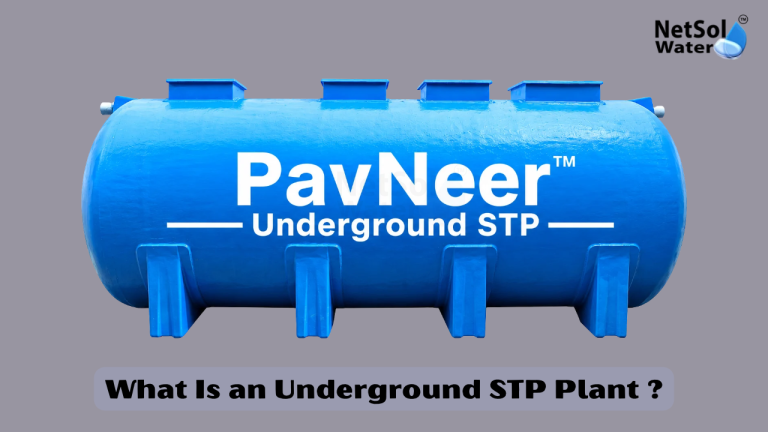
An underground sewage treatment plant is a typical STP wherein its tanks are located underground, which may be situated in a basement or within an RCC or semi-buried chamber. The plant works with the same process, dealing with the same sewage that an above-ground plant deals with, going through the same processes of screening, equalization, biological process, separation, disinfection, and sludge. The difference lies in the construction, the air circulation, and the means to guard against water logging. In this blog we will discuss about the what is an underground STP plant and how does it work step by step process.
Why Do Sites in India Choose Underground STP Plants?
Indian plots are usually constructed on nearly the whole land available. The setbacks, parking, lawns, and building itself leave hardly any space available for the treatment plant to be placed on the ground level. If the tanks are buried underground, then the surface can still be used either as a garden, driveway or parking lot.
However, there are several negative aspects related to it – the plant has to be installed underground, which means that its construction and maintenance have to take place underground too. This factor influences design, air flow and technician access to the equipment. All these issues will be addressed further on.
What Are the Main Stages of an Underground STP Process?
Sewage moves through a sequence of stages. Each one has a job, and each one depends on the stage before it. Understanding the sequence is the best way to judge whether a proposed design makes sense.
Stage 1: How Does Screening Protect the Rest of the Plant?
The sewage from the building goes into the screen chamber, which helps in collecting the rags, plastics, sanitary items, and other coarse particles. Grit chamber allows the sand and grit to settle so that these do not affect the working of the pumps or collect in the tanks.
It is important to remove screenings regularly and cover them, as they are the main reason for odor at underground treatment facilities. The decomposition of screenings takes place quickly in the warm environment. If the screen is not cleaned at the right time, there will be blockages and strain on the pumps.
Stage 2: Why Is Equalisation Needed Before Biological Treatment?
The equalisation tank will store the surges of sewage during the morning and evening periods, releasing the flow evenly. It is important to note that biological processes operate more efficiently under fairly constant flow rates. The peak sewage flow could overwhelm the bacteria or result in lower efficiency until the population is re-established.
For instance, suppose we are designing a facility with 50 m³ per day and with an equalisation retention time of 6 hours. Then, the equalisation capacity equals approximately 50 × 6 ÷ 24 = 12.5 m³. Of course, the actual number is determined by the flow curve, which needs to be measured prior to the design process.
Stage 3: How Does Biological Treatment Remove the Organic Load?
The microorganisms within the aeration tank utilize the organic materials within the sewage. Blowers provide oxygen to the microorganisms with diffusers at the bottom of the aeration tank. Different systems that can be used in underground sewage treatment plants include MBBR, Extended Aeration, and Membrane Bioreactors. This depends on the quality of effluent required, space, and the capacity of the building.
There is a requirement for a constant oxygen supply in the aeration tank. Dissolved oxygen levels must be monitored in different points, since irregular oxygen supply is one of the most common hidden problems in a system like this.
Stage 4: How Is Clean Water Separated From the Biomass?
In a standard plant, there will be a clarifier, which is used for the separation of the biomass and allowing the clean water to flow out through the top portion. Case of the membrane bioreactor, the membrane takes care of the separation process while the solids remain in the process. In either case, the biomass remains in the system while the clean water leaves.
The clarifier/membrane vessel is the process step where problems might arise in case of changes in the load, therefore, it must be monitored every week regardless of whether the outlet is clear or not.
Stage 5: Why Does Disinfection Matter Before Discharge or Reuse?
Disinfection of the treated water using chlorine or ultraviolet rays must be done before discharging it or reusing it. The amount or UV intensity must be proportional to the flow rate due to the decrease in the contact time at peak flow. The residual amount in case of the chlorine must be measured at the discharge point and not the dosing point alone, because the former has no significance at all.
Stage 6: How Is Sludge Removed and Handled?
Excess biomass is wasted from the process into a sludge holding tank. The sludge should be thickened or dewatered where possible to reduce the volume, and it should be removed on a fixed schedule. In an underground plant, the sludge pump and the holding tank must be reachable for servicing, and the removal route must be planned before the tanks are built.
What Equipment Does an Underground STP Need?
A typical underground plant includes the following components. Their exact arrangement depends on the process and the site.
1) Screen and grit chamber, with a removable screen basket
2) Equalisation tank with mixing or aeration to prevent settling and septic conditions
3) Aeration tank with blowers, diffusers, and controls
4) Clarifier or membrane tank, depending on the process
5) Disinfection chamber, with dosing equipment or a UV unit
6) Sludge holding tank and a sump pump for transfer
7) Control panel, level sensors, and an alarm system
8) Ventilation fan or a designed passive airflow path
9) Access covers, manholes, and a safe working route for the technician
What Are Underground STP Tanks Made Of?
Two types of tanks used in underground plants include reinforced concrete (RCC) tanks and prefabricated fibre-reinforced plastic (FRP) tanks. The reinforced concrete tanks are poured at the construction site and thus suitable for large-size plants and flexible layout while prefabricated tanks are manufactured elsewhere and lowered into the excavated hole to reduce on-site activities.
The fibre-reinforced plastic tanks resist corrosion caused by sewage gases and dissolving salts in steel, and they are lighter than the concrete tanks. Thus, it is easier to move them even to the construction site that has limited space. However, the FRP tanks cannot be considered as a solution for all types of situations. The efficiency of the FRP tanks depends on the design by the manufacturer and installation and the depth of the water table. A floating FRP tank in a high water table needs to be fixed with concrete bases and ground anchors.
Which Questions Should You Ask About FRP Tanks?
A) What is the tank’s design pressure rating for earth and groundwater loads?
B) What anchorage or buoyancy restraint does the manufacturer specify for our water table?
C) What backfill material and compaction does the installation guide require?
D) Is the tank rated for vehicle or surface loads, and if so, at what depth?
E) Where is the manufacturer’s data sheet, and does it cover our tank size?
What Site Conditions Affect an Underground STP?
How Does the Groundwater Level Change the Design?
Higher water table raises the possibility of water seeping into the tanks. It might need dewatering during construction process, and the structure needs to be waterproofed to withstand the pressure coming from the outside. Prior to deciding on the final depth of the tank, determine the level of groundwater present in the locality.
What Flood Protection Does a Low-Lying Site Need?
Some pieces of land in Indian cities are low enough to get flooded in case of heavy rains. The access covers, vents, and the electric panels should be positioned above the maximum expected flood level at the site. The surface water should be drained away from the building and a sump with a pump should collect all the water seeped in.
How Is Odour and Gas Controlled Underground?
The enclosed tanks can accumulate hydrogen sulphide gas and other gases, in case of no flow-through ventilation system. The ventilation system should be designed initially, and the venting outlet should be far away from the windows, balconies, and walkways of the property. Inadequate ventilation is the most common complaint against the underground plants.
How Will Technicians Access the Equipment?
Blowers, pumps, and the sludge route must be reachable without dismantling the structure. Removing a blower from a deep chamber is harder than lifting it from an open room, so the removal route, the lifting arrangement, and the working space should be settled before the tanks are poured.
What Should You Ask Before Choosing an Underground Plant?
1) What design flow was used, and what peak factor was applied to it?
2) What is the groundwater level, and how is waterproofing specified against it?
3) How will air be moved through the tanks, and where does the vent discharge?
4) How are blowers and pumps removed for servicing?
5) What does the plant do during heavy rain or a power cut?
Conclusion
An underground STP treats sewage through the same stages as any other plant. The construction, the ventilation, and the access are what change, and those points decide whether the plant runs well for years. Designing them carefully at the start costs far less than correcting them after the tanks are in the ground.
NetSol designs Underground STP Plant for Indian sites, beginning with a flow assessment, a groundwater check, and an access plan before any civil design is fixed. Talk to NetSol about an underground STP for your site or message us on WhatsApp at +91 9650608473.
FAQ
A) Is an underground STP as effective as an above-ground plant?
Answer: Yes, when both are designed for the same flow and the same effluent target. The biological and disinfection stages work the same way. The difference lies in construction, ventilation, and access, which need careful planning underground.
B) Does an underground STP produce odour?
Answer: It can, if air is not managed. Covered tanks need a ventilation system and a vent outlet placed away from living spaces. When this is designed properly, odour is controlled.
C) How deep are underground STP tanks usually built?
Answer: Depth depends on the process, the groundwater level, and the site. The design engineer should set it after a site check rather than assume a figure. Local rules may also apply.
D) Can an underground STP be built in a basement?
Answer: Yes. A basement plant needs ventilation, drainage, waterproofing, and a route for removing equipment. The basement’s flood exposure should be assessed before the design is fixed.
E) What maintenance does an underground STP need?
Answer: Routine work includes screen and grit cleaning, blower and diffuser servicing, sludge removal, chemical dosing checks, and periodic inspection of the tanks. Access points and the sludge route must stay clear.
F) How long does an underground STP last?
Answer: The concrete structure can last many years with proper waterproofing and maintenance. Mechanical parts such as blowers and pumps need replacement on schedules that depend on their running hours and how well they are looked after.