
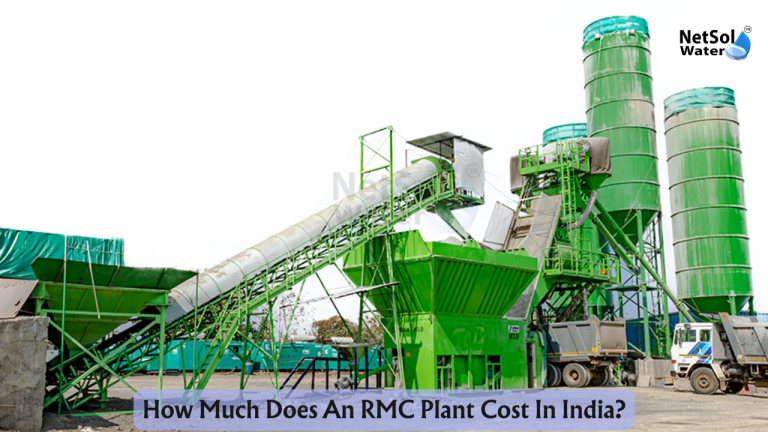
India’s ready mix concrete business has grown into a massive industry. Recent market reports put the sector’s value at roughly USD 78 billion, with volumes crossing 249 million cubic metres a year, and growth expected to continue at a strong pace through 2030. This growth is one big reason why so many entrepreneurs, contractors, and construction companies are now asking the same question: how much does it actually cost to set up an RMC plant in India?
The honest answer is: it depends. An RMC plant is not a single fixed product with one price tag. The cost changes based on capacity, automation level, land, location, and the type of plant you choose. In this blog, we will break down every part of this cost so you get a clear, realistic picture before you invest.
What Exactly Is an RMC Plant?
An RMC plant, or Ready Mix Concrete plant, is a facility where cement, sand, aggregates, water, and admixtures are mixed in fixed proportions using automated batching systems. The concrete is then transported to construction sites in transit mixers, ready to be poured. This is different from mixing concrete manually on site, which is slower, less consistent, and harder to scale for large projects.
Because RMC plants come in different sizes and configurations, from small mobile units to large, fully automated stationary plants, the cost of setting one up can range quite widely, from a few lakhs for a very basic small unit, to several crores for a large, high-capacity setup.
Broad Price Range for RMC Plants in India
Based on current market pricing, here is a general idea of what you can expect:
1) Small/basic batching units: Starting from around ₹4 lakh to ₹12 lakh for very compact machines with lower output.
2) Mid-size plants: Roughly ₹40 lakh to ₹1.5 crore, depending on capacity and automation.
3) Large, fully automated stationary plants: Can go anywhere from ₹1.5 crore to ₹5 crore or more, especially when land, transit mixers, and infrastructure are included.
These numbers are only a starting point. The real cost of running a complete RMC business includes much more than just the batching machine itself, which we will break down next.
Factors That Decide the Total Cost :
1. Plant Capacity
This is the single biggest factor. RMC plants are usually rated by how many cubic metres of concrete they can produce per hour, with common capacities ranging from around 20 cubic metres an hour for smaller plants to well over 100 cubic metres an hour for large, high-output setups. Naturally, higher capacity means bigger machines, stronger structures, more automation, and a higher price tag.
If you’re planning to supply concrete for small to mid-size local projects, a smaller capacity plant may be enough. But if you’re targeting large infrastructure projects, townships, or bulk commercial orders, you will need a higher capacity plant, which pushes the investment up significantly.
2. Land Cost
Setting up an RMC plant typically needs one to two acres of land, depending on the plant size, storage requirements, and space needed for transit mixer movement. Land cost varies enormously depending on whether you’re setting up near a city, on the outskirts, or in a semi-industrial zone. In and around major metros, land alone can account for a large share of your total budget, while in smaller towns or industrial belts, it can be far more affordable.
Many entrepreneurs choose to lease land instead of buying it outright, especially in the early stages, to reduce the initial capital needed.
3. Civil Construction and Site Infrastructure
Beyond the plant machinery, you need civil work such as a solid foundation for the batching plant, storage sheds or silos for cement, aggregate storage yards, a weighbridge, water storage and treatment setup, an office structure, and proper drainage and flooring for vehicle movement. This civil and infrastructure work generally adds a meaningful chunk to the total project cost and should never be underestimated during planning.
4. Batching Plant Machinery
This is the core investment; the actual batching and mixing system that measures and blends cement, aggregates, water, and admixtures. Costs here depend on the type of mixer (twin shaft, pan mixer, or planetary mixer), the level of automation in the control system, and the brand or manufacturer you choose. More advanced automation, better weighing accuracy, and higher build quality naturally push the price higher, but they also improve consistency and reduce long-term operating issues.
5. Transit Mixers
Transit mixers are the trucks that carry ready mixed concrete from the plant to the construction site. Each transit mixer is a separate investment, and most businesses need more than one to handle regular deliveries, especially if projects are spread across different locations. The number of mixers you need depends on how far your typical delivery sites are and how much daily output you’re planning for.
6. Automation and Control Systems
Modern RMC plants use computerised control systems to manage batching accuracy, record production data, and reduce manual error. While a basic manual or semi-automatic system costs less upfront, a fully automatic system offers better accuracy, consistency, and reporting, which matters a lot for large clients and government projects that demand strict quality documentation. Many businesses treat this as a worthwhile long-term investment rather than a place to cut costs.
7. Licences, Registrations, and Approvals
Running an RMC plant legally requires several approvals, including pollution control clearance, Legal Metrology registration for weighing equipment, GST registration, and local municipal or industrial permissions depending on your state and location. While these costs are relatively small compared to machinery and land, they still need to be budgeted for, along with the time it takes to get them processed.
8. Working Capital
Beyond the one-time setup cost, you need working capital to cover the first few months of operations, including raw material purchases (cement, sand, aggregate, admixtures), staff salaries, fuel and maintenance for transit mixers, electricity and water bills, and day-to-day operational expenses before regular revenue starts flowing in steadily. Many new businesses underestimate this and run into cash flow trouble in the first few months, so it’s wise to plan for at least three months of working capital in advance.
A Realistic Total Investment Range
When you put all of the above together, land, civil work, machinery, transit mixers, automation, licences, and working capital, the total investment for a new RMC plant in India generally falls somewhere between ₹1.5 crore on the lower end for a modest setup, and ₹5 crore or more for a large, fully automated plant with multiple transit mixers.
Smaller entrepreneurs sometimes start with a more basic setup, with a lower capacity plant and fewer mixers, bringing the entry cost down closer to ₹50 lakh to ₹1 crore, and scale up as the business grows. This phased approach is quite common and reduces the initial financial risk.
Cost of RMC Concrete Itself (Per Cubic Metre)
If you’re not setting up your own plant but simply want to know what buying ready mix concrete costs, prices generally range from around ₹3,800 to over ₹8,000 per cubic metre, depending on the grade of concrete, your location, and how far the delivery site is from the plant. Standard grades commonly used in residential and commercial construction typically fall in the ₹4,000 to ₹5,500 range, while higher-strength grades used in specialised structures can cost considerably more.
This is useful to know whether you’re a contractor buying RMC for a project, or an entrepreneur trying to estimate what price point you can offer to customers once your own plant is operational.
How Long Does It Take to Recover the Investment?
One of the first questions most entrepreneurs ask is how quickly an RMC plant can pay for itself. This depends heavily on how consistently the plant is utilised. A plant running at a healthy capacity, with steady orders from builders, contractors, and government projects, can start showing decent returns within two to four years, especially once the initial setup and working capital costs are recovered.
The profit margin on ready mix concrete usually comes from the difference between the raw material cost per cubic metre and the price charged to customers, minus operational expenses like fuel, labour, and maintenance. Plants located near active construction zones, with lower transport distances and higher order volumes, tend to recover their investment faster than plants set up in areas with limited nearby demand. This is why location planning matters just as much as machinery selection when calculating your expected returns.
New Plant vs Used Plant: Does Buying Second-Hand Save Money?
Some entrepreneurs consider buying a used or refurbished RMC plant to reduce the initial investment. This can bring down machinery costs noticeably, sometimes by a significant margin compared to a new plant. However, it comes with its own risks, including older automation technology, higher maintenance needs, and uncertainty about the remaining working life of key components like the mixer and weighing systems.
If you do consider a used plant, it’s worth getting it inspected by someone with technical knowledge of batching systems before finalising the purchase, and factoring in a reasonable budget for repairs or upgrades. For many first-time buyers, a new plant, even a smaller capacity one, tends to offer more predictable performance and fewer unexpected costs in the first couple of years.
State-Wise Cost Differences
While machinery costs don’t change dramatically from state to state, other components of the total investment, particularly land and labour, can vary quite a bit depending on where you set up. Land near major metro cities like Mumbai, Delhi, or Bengaluru tends to cost significantly more than land in tier-2 or tier-3 towns, or in dedicated industrial zones. Similarly, minimum wage rates, transport fuel costs, and local approval timelines differ from one state to another.
Because of this, many entrepreneurs choose to set up their RMC plant slightly outside the main city limits, in industrial areas or along highways, where land is more affordable but the site is still close enough to reach major construction hubs within a reasonable delivery time. This balance between land cost and delivery distance is one of the most important location decisions in the entire planning process.
Should You Buy New or Consider a Smaller Setup First?
If capital is a concern, it’s worth considering whether a smaller capacity plant, or even a good quality semi-automatic setup, can meet your initial business needs before jumping straight to a large, fully automated plant. Many successful RMC businesses in India started small, built a reliable client base, proved their quality and delivery consistency, and then reinvested profits into expanding capacity.
On the other hand, if you already have committed large-scale orders, such as a long-term supply contract for an infrastructure project, it may make more financial sense to invest in a higher capacity plant right from the start, since the returns and utilisation will justify the bigger investment sooner.
Final Thoughts
There is no single fixed price for an RMC plant in India, and anyone who tells you an exact number without understanding your capacity needs, location, and business goals is likely giving you an incomplete picture. The real cost depends on how big you want to start, where you’re setting up, how automated you want your operations to be, and how quickly you plan to scale.
The smartest approach is to start with a clear understanding of your target market and expected order volume, then work backward to decide the right plant capacity and configuration. This way, your investment matches your actual business need instead of being based on guesswork.
If you’re planning to set up an RMC plant and want guidance on choosing the right capacity, configuration, and budget for your specific requirement, it always helps to talk to a team with hands-on experience in RMC plant manufacturing before you finalise anything.
FAQs
1) What is the minimum investment needed to start an RMC plant in India?
A basic, smaller capacity setup can start from around ₹50 lakh to ₹1 crore, while a large, fully automated plant with multiple transit mixers can go up to ₹5 crore or more.
2) How much land is required for an RMC plant?
Most RMC plants need around one to two acres, depending on the plant capacity, storage requirements, and space needed for transit mixer movement.
3) Is a used RMC plant a good option for first-time buyers?
It can reduce upfront cost, but it also carries risks like older technology and uncertain equipment life. A technical inspection before buying is strongly recommended.
4) How long does it take to recover the investment in an RMC plant?
With steady order volume and a good location, most plants start showing healthy returns within two to four years, though this varies based on utilisation and local demand.
5) Does the cost of an RMC plant vary by state?
Machinery costs stay fairly similar across states, but land, labour, and approval costs can differ quite a bit depending on where you set up.