
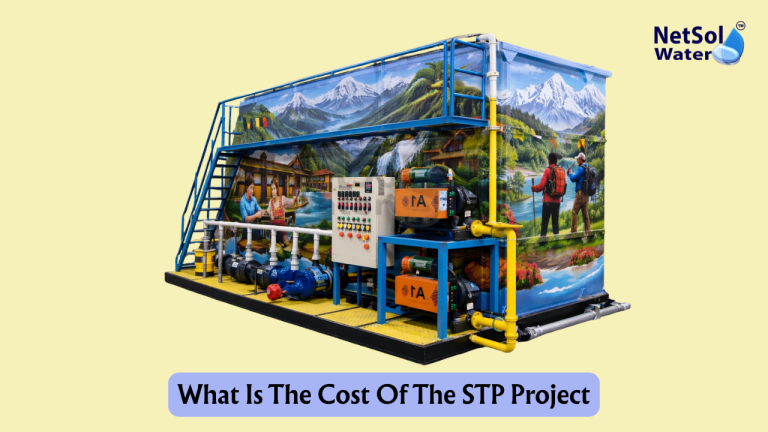
Planning an STP project but you are not sure about the budget at all? This guide sort of unpacks each cost part, so you can map it with real numbers not guesses, and you know where the money really goes.
Getting the cost of a sewage treatment plant wrong during the planning stage can lead to budget overruns, timeline delays, and in many situations, a plant that is undersized or, the opposite, over-engineered for your real demand. It happens more often than people think, and it feels messy later.
Commercial RO Plant has designed and commissioned more than 1000 STP installations across India. This guide is built from that real project experience.
15+ Years Experience | 1000+ Installations | 20+ States Served | ISO Certified
Get A Free Cost Estimate
Why STP Project Cost Varies So Much
This is the first thing to understand when budgeting an STP project. The cost of a sewage treatment plant is not a fixed number you can look up in a catalogue. It is the result of several variables that interact with each other.
A 50 KLD STP for a hospital costs differently from a 50 KLD STP for a housing society. An underground system costs more than a surface-mounted one at the same capacity. A plant built for water reuse costs more than one built purely for discharge compliance.
This page gives you a clear breakdown of every factor that affects STP project cost, indicative price ranges by capacity, a cost comparison across major technologies, and answers to the questions most project planners ask before they get to a formal quote.
By the end of this page you will have a realistic budget range for your project and a clear understanding of where the money goes.
The Seven Factors That Determine STP Project Cost
1) Factor 1: Plant Capacity
Capacity is measured in KLD, which stands for kilolitres per day. It is the single biggest cost driver in any STP project. As capacity increases, cost per KLD generally decreases because fixed cost components like control systems, blowers, and civil structures are shared across a larger treatment volume.
Getting capacity right matters. An undersized plant creates compliance problems immediately. An oversized plant wastes capital and increases operating costs without benefit. Capacity should be calculated from your actual daily sewage generation, not from a rough estimate.
2) Factor 2: Technology Selection
The biological treatment technology you choose directly affects both capital cost and operating cost. The three main options for most applications in India are MBBR, SBR, and MBR. Each has a different cost profile.
MBBR is generally the most cost-effective for standard compliance requirements. SBR sits in the mid range and delivers excellent output consistency. MBR is the most capital-intensive but produces the highest quality treated water and is the right choice when reuse is a design requirement.
Choosing the wrong technology at the design stage means either overpaying for performance you do not need, or underinvesting and failing to meet compliance standards.
3) Factor 3: Civil Construction Scope
Civil work is often the largest single cost component in a full-scope Sewage Treatment Plant project. Underground systems require excavation, waterproofing, and structural concrete work that adds significant cost. Surface-mounted systems on prepared ground cost considerably less.
Soil conditions matter too. Rocky ground costs more to excavate than normal soil. High groundwater table locations need additional waterproofing. These site-specific factors can shift the civil cost significantly in either direction.
4) Factor 4: Treated Water Reuse Requirement
A plant designed purely for discharge compliance needs fewer treatment stages than one designed to produce water suitable for reuse. If your project requires reuse-grade output, you will need tertiary treatment stages including filtration and disinfection added to the standard secondary treatment process.
This adds to capital cost. However, for projects where reuse means a measurable reduction in fresh water purchase costs, the additional capital typically pays back within two to four years.
5) Factor 5: Sludge Management System
Every STP produces sludge as a byproduct of the treatment process. How that sludge is handled, stored, dewatered, and disposed of is a cost component that many project budgets underestimate.
A basic sludge drying bed is the least expensive option. A mechanical sludge dewatering system using a filter press or centrifuge is more expensive but more practical for larger capacities and sites where open drying beds are not feasible.
6) Factor 6: Automation And Instrumentation Level
A manually operated system with basic controls tends to cost less upfront, but honestly it eats up more skilled operator time, and the output can be kind of hit or miss—less consistent. A fully automated setup with PLC control, SCADA monitoring , and remote access costs more at the beginning, but it lowers the need for humans day to day, and over time it gives steadier performance that you can actually count on.
For most commercial and industrial clients, a mid-level automation package feels like that balanced middle, where the capital cost stays reasonable while operating reliability is maintained.
7) Factor 7: Location And Site Access
Transportation of equipment to remote or difficult-access sites adds cost. Local construction material prices vary by region. Labour costs differ across states. A project in a Tier 1 city with good access will have a different cost profile from an equivalent project in a remote industrial zone even at the same capacity and specification.
STP Cost By Capacity: Indicative Price Ranges
These ranges reflect real project costs across India based on Commercial RO Plant’s installation experience. They include equipment supply, basic civil work, installation, and commissioning. They assume a standard ground-level installation with MBBR technology unless noted.
| Capacity | Indicative Cost Range | Typical Application |
| 1 KLD | Rs. 2 Lakh to Rs. 4 Lakh | Small residential, individual bungalow |
| 5 KLD | Rs. 6 Lakh to Rs. 12 Lakh | Small apartment complex, boutique hotel |
| 10 KLD | Rs. 12 Lakh to Rs. 22 Lakh | Mid-size residential society, small hospital |
| 25 KLD | Rs. 25 Lakh to Rs. 45 Lakh | Large residential complex, mid-size hotel |
| 50 KLD | Rs. 45 Lakh to Rs. 80 Lakh | Large hotel, hospital, industrial facility |
| 100 KLD | Rs. 80 Lakh to Rs. 1.5 Crore | Large industrial plant, township, institution |
| 250 KLD | Rs. 1.8 Crore to Rs. 3.2 Crore | Large industrial complex, government project |
| 500 KLD | Rs. 3.5 Crore to Rs. 6 Crore | Municipal application, large township |
These are indicative ranges only. Your actual project cost will depend on the specific factors described in this guide. Contact Commercial RO Plant for a detailed project-specific cost estimate.
STP Cost By Technology: How The Choice Affects Your Budget
A) MBBR Technology Cost Profile
Moving Bed Biofilm Reactor systems are the most widely installed STP technology in India for mid-range applications. They offer a good balance of capital cost, operating simplicity, and compliance reliability.
Capital cost is moderate. Operating cost is low to moderate. Maintenance is relatively straightforward. MBBR systems handle load variation well and are forgiving of operator inconsistency compared to more complex systems.
Best suited for residential societies, hotels, educational institutions, and industrial applications where standard discharge compliance is the primary requirement and space is limited.
B) SBR Technology Cost Profile
Sequencing Batch Reactor systems treat wastewater in timed cycles within a single tank. The capital cost is similar to MBBR in most configurations. The advantage of SBR is highly consistent output quality and strong automation potential.
SBR systems produce very stable treated water quality because each treatment cycle is controlled precisely. They are well suited for applications where output consistency is critical and where good automation infrastructure is in place.
Operating costs are comparable to MBBR. Maintenance requires good understanding of the cycle programming and timer systems.
C) MBR Technology Cost Profile
Membrane Bioreactor systems are the premium option in biological sewage treatment. Capital cost is 30 to 50 percent higher than MBBR or SBR at the same capacity, primarily because of the cost of the membrane modules.
The output quality is significantly higher than either MBBR or SBR. Treated water from an MBR system can typically be reused for toilet flushing, irrigation, and in some cases cooling tower makeup without additional treatment stages.
For projects where water reuse is a design objective or where regulatory standards are particularly strict, MBR is the right technology despite the higher capital cost. The operating saving from reduced fresh water purchase often recovers the additional capital within three to five years.
| Technology | Relative Capital Cost | Output Quality | Best For |
| MBBR | Moderate | Good | Standard compliance, space-constrained sites |
| SBR | Moderate | Very Good | Consistent output, automated operation |
| MBR | Higher | Excellent | Water reuse, strict compliance requirements |
| Packaged STP | Low to Moderate | Good | Small capacity, fast installation, remote sites |
What Is Included In A Turnkey STP Project Cost
When you receive a turnkey STP project quote from Commercial RO Plant, here is what that cost covers.
1) Civil Design Inputs: We provide the structural and civil design specifications your civil contractor needs to build the correct foundation and tank structures for the system.
2) Equipment Supply: All mechanical and electrical equipment including blowers, pumps, media, membrane modules where applicable, piping, valves, and instrumentation.
3) Fabrication: For packaged systems, factory fabrication and quality inspection before dispatch to site.
4) Installation: On-site installation of all equipment, piping connections, electrical connections, and control system integration.
5) Commissioning: Full system startup, performance testing, and verification that output meets specified parameters.
6) Operator Training: Training for your facility team on day-to-day operation, routine maintenance, and early fault identification.
7) Documentation: Operation and maintenance manuals, as-built drawings, and equipment warranties.
8) What is typically not included in a base turnkey quote: civil construction cost if handled by a separate contractor, land, power connection infrastructure, and consumables beyond the initial startup quantity.
Operating Cost: What An STP Costs To Run Every Month
Capital cost is a one-time investment. Operating cost is what you pay every month for the life of the system. For a 15-year asset, the total operating cost over the system’s life often exceeds the original capital cost.
Monthly Operating Cost Components
Power consumption is typically the largest monthly operating cost. A well-designed MBBR or SBR system consumes between 0.5 and 1.5 kWh per KLD of treated water. At a 10 KLD capacity running 24 hours, this translates to 5 to 15 units of electricity per day.
Consumables include dosing chemicals for pH correction and disinfection, filter media replacement, and membrane cleaning chemicals for MBR systems.
Sludge disposal is a cost that depends on your local disposal options. Mechanical dewatering reduces sludge volume and therefore disposal cost, but adds to energy consumption.
Maintenance costs under a structured AMC are predictable and typically range from 5 to 10 percent of the capital cost annually, depending on system complexity and coverage level.
Indicative Monthly Operating Cost By Capacity
| Capacity | Estimated Monthly Operating Cost |
| 10 KLD | Rs. 8,000 to Rs. 18,000 |
| 25 KLD | Rs. 18,000 to Rs. 35,000 |
| 50 KLD | Rs. 30,000 to Rs. 60,000 |
| 100 KLD | Rs. 55,000 to Rs. 1,10,000 |
How To Reduce Your STP Project Cost Without Compromising Performance
The most effective cost control measure is accurate capacity calculation. Oversized systems cost more to build and more to operate. Work with your STP manufacturer to calculate capacity from actual measured or estimated daily sewage flows, not from conservative rule-of-thumb estimates.
A) Consider Phased Expansion
If your capacity requirement will grow over time, a phased design allows you to install what you need now with civil infrastructure sized for future expansion. This spreads capital expenditure over time and avoids paying for unused capacity today.
B) Choose Technology That Matches Your Requirement
MBR is an excellent technology but it is not right for every application. If your project requires standard discharge compliance and water reuse is not a priority, MBBR or SBR will deliver compliant performance at lower capital and operating cost.
C) Plan Civil Work Carefully
Underground systems cost more than surface-mounted ones. If your site allows surface or semi-underground installation, this is a straightforward way to reduce civil cost without affecting system performance.
D) Structure Your AMC Properly
A well-structured AMC prevents expensive emergency repairs by keeping the system in good condition through regular preventive maintenance. The cost of a good AMC is almost always lower than the cost of reactive repair and downtime combined.
CPCB Compliance And Its Impact On STP Design Cost
The Central Pollution Control Board sets discharge standards that every STP must meet before treated water can be released into drains, water bodies, or land. The key parameters are BOD below 10 to 30 mg/L depending on the application, COD below 250 mg/L, TSS below 10 to 30 mg/L, and pH between 5.5 and 9.
Meeting these standards consistently requires a properly designed system with adequate treatment stages. A system that cuts corners on design to reduce capital cost will fail compliance testing and leave you facing pollution board penalties that exceed the cost saved.
State-Level Standards Add Complexity
Beyond CPCB standards, state pollution control boards often impose additional requirements. Haryana, Delhi, and Maharashtra for example have specific standards for certain categories of discharge. A manufacturer with experience across multiple states understands these variations and designs accordingly.
Commercial RO Plant designs every system to meet both CPCB standards and the applicable state-level requirements for your project location.
Our Presence Across India
Commercial RO Plant designs and installs sewage treatment plants with pricing and project management adapted to local conditions across India.
1) STP Manufacturer In Haryana
Serving Faridabad, Gurugram, Panipat, Sonipat, Ambala, Rohtak, and surrounding districts.
2) STP Manufacturer In Rajasthan
Serving Jaipur, Jodhpur, Udaipur, Kota, Ajmer, and industrial zones across the state.
3) STP Manufacturer In Delhi NCR
Serving Delhi, Noida, Greater Noida, Ghaziabad, and the broader NCR region.
4) STP Manufacturer In Gujarat
Serving Ahmedabad, Surat, Vadodara, Rajkot, and major industrial corridors.
5) STP Manufacturer In Uttar Pradesh
Serving Lucknow, Kanpur, Agra, Meerut, Prayagraj, and industrial belts across UP.
If your project is in a region not listed here, contact us. Our installation and service network covers more than 20 states across India.
Why Commercial RO Plant Is The Right Choice For Your STP Project
A) Engineering Before Sales
We give you a cost estimate based on your actual project requirements, not a low number designed to win the order and then revised upward later. Our proposals are detailed, itemised, and based on a proper understanding of your site and your effluent.
B) ISO Certified Manufacturer
Commercial RO Plant is an ISO certified STP manufacturer and supplier. Our manufacturing processes, quality control, and project delivery follow independently verified standards. This matters for regulated industries and for clients who want confidence in a long-life infrastructure investment.
C) Over 1000 Installations Across India
Our project experience covers every major application category and most states in India. When we give you a cost estimate or a performance projection, it is grounded in real installation data from comparable projects.
D) Transparent Pricing
We itemise our quotations so you know exactly what you are paying for. No hidden costs discovered after you commit. No vague lump sums that shift during execution.
E) Long-Term Partnership
We are not a vendor who sells you equipment and moves on. Our AMC and O&M support keeps us involved in your project for the long term. Your system’s performance after commissioning matters to us because it reflects directly on our reputation.
Get Your Free STP Cost Estimate Today
Tell us about your project and our engineering team will respond within 24 hours with a detailed technical recommendation and an indicative cost range. CRP is the best sewage treatment plant manufacturer at best affordable price and quality.
We need to know your location, your facility type, your approximate daily sewage volume, and your compliance or reuse requirements. That is enough for us to give you a meaningful initial estimate.
Call Us: 9650608473
Email Us: enquiry@netsolwater.com
WhatsApp: +91-9650608473
Frequently Asked Questions About STP Project Cost
1) What Is The Cost Of A 100 KLD STP In India?
A 100 KLD STP project typically costs between Rs. 80 lakh and Rs. 1.5 crore depending on technology, civil scope, site conditions, and whether water reuse treatment is included. MBR technology at this capacity will be at the higher end of this range. MBBR with standard civil work will be at the lower end.
2) Which STP Technology Is Most Cost-Effective?
MBBR offers the lowest capital cost for standard discharge compliance applications. SBR is comparable in capital cost with better output consistency. MBR costs more upfront but delivers reuse-grade water quality that can generate operating savings through reduced fresh water consumption.
3) Is STP Mandatory For My Building Or Facility?
Under NGT orders and various state regulations, STP is mandatory for residential complexes above 50 units or above a specified total built-up area in most states. Hospitals, hotels, industrial facilities, and educational institutions above specified thresholds are also required to install and operate sewage treatment systems.
4) How Long Does An STP Installation Take?
A packaged STP system can be installed and commissioned in four to eight weeks from order confirmation. A custom system with full civil construction typically takes three to six months depending on capacity and site complexity.
5) What Is The Power Consumption Of An STP?
MBBR and SBR systems typically consume 0.5 to 1.5 kWh per KLD. A 50 KLD system running continuously would use between 25 and 75 units of electricity per day.
6) Can STP Treated Water Be Reused And Does It Reduce Costs?
Yes. With appropriate treatment, STP output can be reused for toilet flushing, irrigation, cooling tower makeup, and certain industrial applications. For a 50 KLD system where all treated water is reused at a rate of Rs. 50 per KLD, the saving is Rs. 2,500 per day or roughly Rs. 9 lakh per year.
7) What Happens If My STP Fails A Pollution Board Inspection?
Penalties for non-compliance range from show cause notices to closure orders depending on the severity and frequency of violations. In Haryana, fines and remediation orders are increasingly common for facilities that fail to maintain operational STPs.
8) Does Commercial RO Plant Offer AMC For STP Systems?
Yes. We offer Annual Maintenance Contracts that cover scheduled preventive maintenance, emergency breakdown response, and consumable supply at defined intervals. AMC terms are discussed and agreed before project commissioning so there are no surprises after handover.