
India’s ready mix concrete industry is growing fast. Industry reports value the country’s RMC market at close to USD 78 billion, with volumes touching around 249 million cubic metres a year and steady double-digit growth expected through the rest of this decade. Globally, the ready mix concrete business is worth over a trillion dollars and is still expanding. These numbers tell a simple story: builders across the world are moving away from mixing concrete on site and switching to RMC plants instead. In this blog we will discuss about what are the benefits of rmc plants for large construction projects.
If you are managing a large construction project, whether it is a highway, a metro corridor, a township, or a commercial tower, the concrete you use decides how strong, safe, and long-lasting your structure will be. Site-mixed concrete has served the industry for decades, but it comes with problems that get worse as the project size grows. This is where an RMC plant, or Ready Mix Concrete plant, changes the game.
In this blog, we will walk through what an RMC plant actually does, and why it has become the preferred choice for large construction projects.
What Is an RMC Plant?
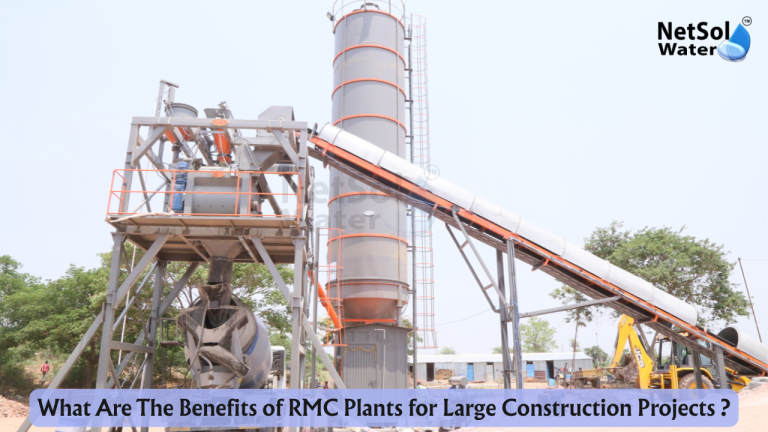
An RMC plant, also called a concrete batching plant, is a facility where cement, sand, aggregates, water, and admixtures are mixed together in exact proportions using automated machines. The concrete is prepared according to a fixed design mix, loaded into transit mixers, and delivered to the site in a ready-to-use condition. There is no need to measure or mix anything manually at the construction site.
This is very different from the old method of mixing concrete by hand or with small mixers on site, where quality depends heavily on the labour doing the work. An RMC plant removes that guesswork and replaces it with a controlled, repeatable process.
Now let’s look at why this matters so much for large projects.
1. Consistent Quality in Every Batch
The biggest advantage of an RMC plant is quality control. When concrete is mixed on site, the ratio of cement, sand, water, and aggregate can change from one batch to the next, depending on who is mixing it and how carefully they measure the materials. Even a small error in the water-cement ratio can weaken the final structure.
In an RMC plant, everything is measured using computerised batching systems. The same design mix is used for every single batch, whether it is the first truckload or the five-hundredth. For large projects where thousands of cubic metres of concrete are needed, this consistency is not just helpful, it is necessary. A small quality slip in one part of a bridge or a high-rise building can turn into a major structural risk later.
2. Faster Project Completion
Time is money on any construction site, and this is even truer for large projects with tight deadlines and heavy penalty clauses for delays. Site mixing is slow. It needs manual labour, storage space for raw materials, and constant supervision.
With an RMC plant, concrete arrives at the site already mixed and ready to pour. Project teams don’t have to wait for materials to be measured, mixed, and checked on site. This saves hours every single day, and over the life of a large project, those hours add up to weeks or even months of time saved. Faster pouring also means formwork can be reused sooner, and the next stage of construction can begin without long gaps.
3. Lower Total Project Cost
Many people assume that RMC is more expensive than site-mixed concrete because you are paying for a service in addition to materials. In reality, the opposite is often true for large projects.
Here’s why. Site mixing requires you to buy and store more raw material than you actually use, because wastage during manual mixing is common. You also need extra labour, mixing machines, storage sheds, and supervisors to manage the entire process. An RMC plant removes most of these costs. You order exactly what you need, when you need it, and you pay only for the concrete delivered. Less wastage, less labour cost, and less equipment investment mean the overall cost per cubic metre often works out lower, especially once you account for the value of time saved.
4. Less Wastage of Raw Material
On a manual mixing site, it’s common to over-order cement, sand, and aggregate just to be safe, since running short mid-pour can cause serious problems. This leads to leftover material that often goes unused or gets wasted due to poor storage and exposure to weather.
An RMC plant works on a demand basis. You specify how much concrete you need for a particular pour, and that is what gets delivered. There’s very little excess, and because the mixing happens in a controlled plant environment, material spillage and wastage are far lower than what happens with open-site mixing.
5. Better Site Management and Less Congestion
Large construction sites already have a lot going on: cranes, workers, material storage, vehicle movement, and multiple contractors working at once. Adding a full concrete mixing setup with cement bags, sand heaps, aggregate stockpiles, and mixing machines to this mix makes the site even more congested and harder to manage.
Using an RMC plant means all of that mixing infrastructure stays off site. The only thing that comes to your project is the transit mixer delivering ready concrete. This frees up valuable space, reduces the number of vehicles and materials moving around the site, and makes it easier for site engineers to manage logistics, safety, and workflow.
6. Reduced Labour Dependency
Skilled labour for concrete mixing is not always easy to find, and labour costs keep rising every year. Manual mixing needs a team dedicated just to measuring, mixing, and monitoring concrete quality throughout the day.
RMC plants cut down this dependency significantly. Since the mixing process is automated, you need far fewer people on site to manage concrete supply. This is particularly useful for large projects spread across remote locations, where finding skilled labour can be a real challenge.
7. Environment-Friendly Construction
Sustainability has become an important part of construction planning, and RMC plants support this in more than one way. Because mixing happens at a centralised, controlled facility, there is less dust, noise, and material spillage at the construction site itself. Water usage is also more efficient, since the plant measures exactly how much is needed for each batch instead of relying on manual estimation.
Many modern RMC plants also recycle water used for washing equipment and manage waste concrete more responsibly than a typical site setup would. For large projects, especially those in urban areas with strict environmental norms, this matters a great deal.
8. Support for Complex and Specialised Structures
Large projects don’t just need plain concrete. Bridges, high-rise buildings, tunnels, and industrial structures often require special concrete mixes, such as high-strength concrete, self-compacting concrete, or concrete with specific additives for durability in harsh weather.
Producing these specialised mixes accurately by hand is extremely difficult and risky. RMC plants are built to handle exactly this kind of precision. They can produce different grades and types of concrete on demand, following exact technical specifications, which is something manual mixing simply cannot match at scale.
9. Continuous Supply for Large Pours
Some parts of large structures, like foundation slabs or bridge decks, need concrete to be poured continuously without breaks, because stopping midway can create weak joints in the structure. This is called a mass or continuous pour, and it needs a steady, uninterrupted supply of concrete.
RMC plants are designed to support this. With multiple transit mixers running back and forth and a batching plant producing concrete continuously, large pours can be completed without the gaps that manual mixing would struggle to avoid.
10. Better Record-Keeping and Accountability
For large projects, documentation matters. Contractors, engineers, and clients need proof of the concrete grade used, the quantity supplied, and the quality tests performed. RMC plants typically maintain digital records of every batch, including the mix design, quantity, and time of production.
This kind of record-keeping is extremely useful during quality audits, structural inspections, or in case of any dispute later. Manual mixing offers almost no reliable way to track this information batch by batch.
Choosing the Right RMC Plant Capacity for a Large Project
Not every large project needs the same size of plant. A mid-size commercial building and a multi-kilometre highway stretch have very different concrete demands, and choosing the wrong capacity can cause its own problems. If the plant is too small for the project, pours get delayed and deadlines slip. If it is oversized, you end up paying for capacity you never use.
RMC plants generally range from smaller units producing around 20 cubic metres an hour to large stationary plants that can produce well over 100 cubic metres an hour. For large infrastructure projects like metro corridors, dams, or expressways, it is common to see multiple plants working together, or a single high-capacity plant placed close to the site to reduce transit time. Project planners usually work backward from the pour schedule: how much concrete is needed per day, how many hours the pour will take, and how far the plant is from the site. This helps decide whether a mobile plant, a semi-stationary plant, or a full stationary batching plant makes more sense.
Location also plays a big role. For projects spread across a large area, such as highways or pipelines, a mobile RMC plant that can be shifted along the route often works out more practical than a single fixed plant. For urban high-rise projects, a stationary plant set up near the site, or a nearby commercial RMC supplier, usually gives better control over delivery timing.
On-Site Plant vs Commercial RMC Supplier
Large contractors sometimes debate whether to set up their own RMC plant at the project site or simply source concrete from a nearby commercial supplier. Both approaches work, and the right choice depends on the size and duration of the project.
Setting up a dedicated on-site plant makes sense for very large, long-duration projects where concrete demand is high and continuous for years, such as major infrastructure corridors or township developments. The upfront investment is higher, but it gives complete control over supply timing and mix design.
For shorter or mid-duration projects, or projects located in cities where multiple RMC suppliers already operate nearby, buying from a commercial plant is usually more practical. It avoids the capital cost of setting up a plant and still delivers all the quality and consistency benefits discussed above. Many large contractors actually use a mix of both approaches across different phases of a project, depending on how demand changes over time.
Is an RMC Plant Right for Every Large Project?
While the benefits are clear, it’s worth mentioning that the value of an RMC plant depends on planning. Project teams need to plan the delivery schedule properly, since ready mix concrete has a limited window before it starts to set. Site access for transit mixers, distance from the batching plant, and traffic conditions also need to be considered while planning pours.
For most large projects, though, these are manageable challenges compared to the risks and costs of manual mixing at scale.
Final Thoughts
Large construction projects carry big responsibilities, tight timelines, strict budgets, and long-term safety expectations. An RMC plant addresses all three by delivering consistent quality, faster execution, lower overall costs, and better site management. As India’s construction and infrastructure sector continues to grow, more contractors and developers are choosing ready mix concrete not because it’s a trend, but because it genuinely solves the problems that come with building at scale.
If you are planning a large project and want to understand which type of RMC plant setup, capacity, or configuration would suit your requirement, it always helps to speak with a team that has real experience in this field before you finalise your equipment or supplier.
FAQs
A) Does RMC cost more than site-mixed concrete?
On paper, the rate per cubic metre may look slightly higher, but once you factor in labour savings, reduced wastage, and faster completion, RMC usually works out more economical for large projects.
B) How far can RMC be transported?
This depends on the concrete grade and the setting time of the mix, but most suppliers plan deliveries so that concrete reaches the site well within its usable window. This is one more reason plant location and site distance need careful planning at the start of a project.
3) Can RMC plants produce different grades for different parts of a project?
Yes. A single plant can switch between mix designs for different structural elements, such as foundations, columns, and slabs, as long as the schedule and quantities are planned in advance.
4) Is an on-site RMC plant always better than buying from a commercial supplier?
Not always. It depends on project size and duration. Long, high-volume projects often justify a dedicated on-site plant, while shorter projects usually do better buying from a nearby commercial supplier.