
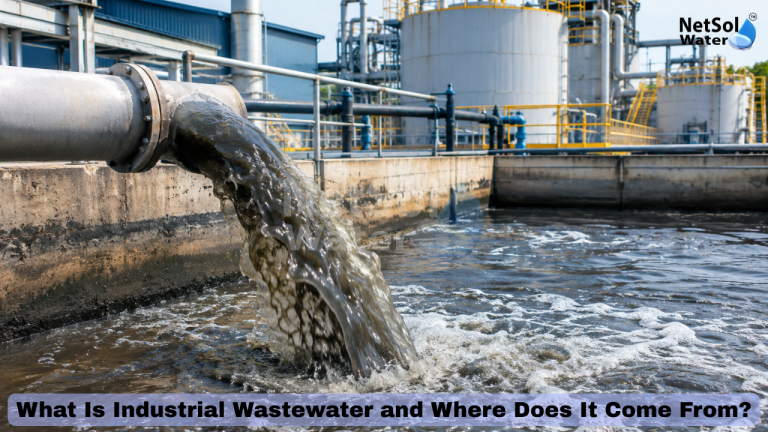
The global industrial wastewater treatment market was valued at USD 20.01 billion in 2025 and is projected to climb to USD 32.22 billion by 2034, according to market research published by Fortune Business Insights, with Asia Pacific alone accounting for 41% of that global spend. Behind that number sits a much starker statistic: the industrial sector consumes roughly 22% of all water used worldwide, and according to UN-Water, roughly 80% of the wastewater generated globally gets discharged back into the environment without adequate treatment. For anyone running a factory, a processing plant, or any operation that touches water as part of its production, understanding exactly what industrial wastewater is, and precisely where it originates within your own process, is the first real step toward treating it properly rather than simply hoping a generic system will handle whatever comes out the drain.
What Actually Counts as Industrial Wastewater Versus Ordinary Sewage?
A Definition That Covers More Than People Expect
Industrial wastewater refers to any water or liquid-carried waste resulting from a manufacturing process, trade, or business activity, distinct from the domestic sewage generated by residential and commercial buildings. This includes discharges from petrochemical, textile, electroplating, pharmaceutical, and food processing operations, each carrying its own mix of organic and inorganic matter, and in many cases, toxic or hazardous substances that ordinary sewage treatment was never designed to handle.
Why the Distinction From Sewage Actually Matters
The reason this classification matters isn’t academic. Municipal sewage treatment plants are engineered around a fairly predictable, relatively low-strength organic load from human waste and household water use. Industrial wastewater, by contrast, can carry heavy metals, synthetic chemicals, oils, and concentrations of organic material many times higher than domestic sewage, which is exactly why regulators require industries to treat their effluent, or pre-treat it to a specific standard, before it ever reaches a shared sewer or a Common Effluent Treatment Plant. A municipal plant simply isn’t biologically or chemically equipped to absorb what a tannery or an electroplating unit produces without that pre-treatment step happening first.
Two Different Ways Engineers Classify Industrial Wastewater
Environmental engineers generally sort industrial wastewater along two separate lines: first, by the specific process that generated it within a facility, such as rinse water from a plating line or cooling water from a heat exchanger, and second, by the industry sector producing it overall, such as textiles or pharmaceuticals. Both classifications matter for design, since two facilities in the same industry can still generate meaningfully different effluent depending on their specific internal processes, raw material choices, and the age or configuration of their equipment.
Why This Broad Legal Definition Includes More Than Obvious Factory Discharge
Under many regulatory frameworks, the definition of industrial wastewater extends beyond the water directly touched by a manufacturing process. It also commonly includes contaminated stormwater runoff and leachate from solid waste facilities, meaning a facility’s environmental obligations don’t stop at what happens inside its production lines, they extend to anything on-site that could carry contamination off the property, whether through a drain, a runoff channel, or groundwater infiltration.
Which Industries Actually Generate the Most Industrial Wastewater?
Water-Intensive Sectors Carry the Heaviest Load
Petroleum refining, textile manufacturing, dairy processing, pharmaceuticals, paint manufacturing, leather processing, and pulp and paper production are consistently identified among the largest industrial water consumers worldwide, and by extension, among the largest generators of industrial wastewater requiring treatment. These sectors share a common thread, water isn’t just an input, it’s actively involved in the chemistry or physical processing at the heart of what they manufacture.
Why Developed and Developing Economies Differ Sharply
Industrial water usage patterns vary considerably by region, with industrialised economies in North America and Europe drawing around 50% of their total water use for industrial purposes, compared to roughly 4-12% in many developing countries, where domestic and agricultural use dominates instead. This gap partly reflects the type of industry present in a given economy, and partly reflects how tightly regulated and metered industrial water use has become in more developed markets, where facilities are required to account for water use and discharge far more precisely than in regions where enforcement infrastructure is still developing.
The Composition Problem: No Two Industries Look Alike
Identifying pollutants in industrial discharge is genuinely difficult precisely because it depends on so many variables, the specific process used, the raw materials involved, and even the region where the facility operates, since regulatory pressure and available technology shape what actually ends up in a factory’s wastewater stream. A textile facility in one country using older dye formulations can produce a genuinely different pollutant profile than a facility in another country using more modern, regulated dye chemistry, even though both are nominally in the same industry.
Why High-Tech and Traditional Manufacturing Produce Different Pollutant Profiles
Because of the high-tech enterprises common in more developed economies, the pollutants generated there often differ meaningfully from those found in developing nations, where more traditional, less automated manufacturing processes tend to dominate. Electronics and semiconductor manufacturing, for instance, introduces specific trace metals and solvents into wastewater that a more conventional textile or food processing operation would never generate, which is exactly why a treatment approach genuinely needs to be built around a facility’s actual industry and technology level, not a generic regional assumption.
Where Inside a Facility Does Wastewater Actually Originate?
Process Water Directly Involved in Manufacturing
The most obvious source is water used directly within a manufacturing process itself, rinse baths in electroplating lines, dye baths in textile operations, or wash water used to clean raw materials before processing. This water typically carries the heaviest and most process-specific pollutant load, since it’s had direct contact with the chemicals or materials central to that industry’s core operation, and it’s usually the stream that drives the majority of a treatment system’s design requirements.
Cooling and Heating System Water
Cooling towers and boiler systems generate their own distinct wastewater stream, cooling tower blowdown and boiler blowdown, carrying concentrated dissolved solids, corrosion inhibitors, and scale control chemicals that build up as water evaporates and cycles through the system repeatedly. This stream is often overlooked in a facility’s overall wastewater accounting, since it isn’t tied to the “core” manufacturing process, yet it can represent a meaningful share of total effluent volume, particularly for facilities with large-scale cooling or steam generation requirements.
Washdown and Cleaning Water
Facility cleaning, equipment washdown, and floor cleaning generate wastewater carrying whatever residue was present on surfaces, oil, grease, product residue, or cleaning chemical themselves, and this stream is often underestimated in volume until a facility actually measures it properly. Food processing facilities in particular can generate surprisingly large washdown volumes given daily hygiene requirements, and this water often carries a genuinely high organic load that needs to be factored into overall treatment capacity.
Stormwater That Contacts Industrial Areas
Contaminated stormwater, rainwater that has run across industrial yards, loading areas, or storage zones, also falls under the industrial wastewater definition in many regulatory frameworks, since it can pick up spilled chemicals, oil, and particulate matter on its way to a drain. Facilities that store raw materials or waste outdoors, or that have open loading and unloading areas, need to think about stormwater management as a genuine part of their wastewater strategy, not a separate issue handled purely through drainage engineering.
Sanitary Wastewater From On-Site Staff
Even facilities with heavy industrial processes still generate ordinary sanitary wastewater from staff washrooms and canteens, a smaller volume stream that typically needs to be managed separately from process wastewater given its very different pollutant profile. Combining this stream with heavily contaminated process water without proper segregation can complicate treatment design unnecessarily, since sanitary wastewater generally responds well to standard biological treatment that shouldn’t need to be sized against a facility’s more hazardous process streams.
What Does a Typical Industry’s Wastewater Actually Contain?
Heavy Metal-Bearing Sectors
Substantial quantities of wastewater containing heavy metals such as chromium, cadmium, lead, copper, zinc, and nickel are generated specifically from iron and steel manufacturing and petrochemical operations, industries where these metals are either directly used in the process or present as contaminants in raw materials. These metals present a genuinely different treatment challenge than organic pollutants, since they can’t be broken down biologically and require dedicated physical or chemical removal.
High-Organic-Load Sectors
Food processing, dairy, and beverage manufacturing generate wastewater rich in proteins, fats, and carbohydrates, resulting in exceptionally high biochemical oxygen demand that requires robust biological treatment to bring down to safe discharge levels. These sectors, while producing pollutants that are ultimately biodegradable, still need treatment systems genuinely sized for the concentration involved, since underestimating organic load is one of the most common design failures in this category.
Chemical-Intensive Sectors
Textile dyeing, pharmaceutical manufacturing, and paint production generate wastewater carrying dyes, synthetic organic compounds, and specialty chemicals, elevated levels of fats, cleaning agents, volatile compounds, and oil that pose genuine risks to both human health and the environment if discharged untreated. These sectors frequently need treatment approaches that go beyond standard biological processes entirely, given how resistant many of these compounds are to natural degradation.
Why Does This Water Matter So Much Once It Leaves a Facility?
The Human Health Cost of Poor Management
The World Health Organization attributed roughly 1.6 million deaths in 2018 to water pollution, a figure that underscores just how directly poorly managed industrial and other wastewater streams translate into real human harm once they reach drinking water sources or contaminate food and agricultural systems downstream. This isn’t an abstract environmental statistic, it reflects communities living near contaminated water sources, agricultural land irrigated with polluted water, and fisheries affected by industrial discharge.
A Global Water Scarcity Problem Getting Worse, Not Better
The United Nations Sustainable Development Goal 6, focused on ensuring universal access to clean water and sanitation, has grown more urgent given estimates that more than a billion people may face water shortages, a crisis that untreated industrial discharge actively worsens by contaminating available freshwater sources that communities and agriculture both depend on. Every litre of industrial wastewater discharged without adequate treatment effectively removes a usable resource from an already strained global supply.
Regulatory Pressure Is Intensifying Across Major Economies
Countries including China and India have implemented progressively stricter wastewater discharge norms in recent years, driven by rapid industrialisation, urban growth, and mounting water scarcity concerns, a trend reflected directly in market growth, with China’s industrial wastewater treatment market projected to reach USD 3.31 billion and India’s projected to reach USD 2.59 billion by 2026 alone. This regulatory tightening shows no sign of reversing, and facilities that design treatment systems only against today’s requirement risk finding themselves out of compliance within just a few years.
Is Industrial Wastewater Still Seen Purely as a Liability, or Is That Changing?
A Genuine Shift Toward Treating Wastewater as a Resource
Industry thinking has moved noticeably in recent years, replacing the older, purely reactive approach of meeting discharge standards and moving on, with a more proactive mindset that views wastewater as a strategic resource rather than pure liability. Facilities increasingly design for reuse at the source, treating process water on-site so it can safely re-enter production rather than being discharged and replaced with fresh intake.
Why This Shift Makes Business Sense, Not Just Environmental Sense
This circular approach reduces both discharge volumes and fresh water consumption simultaneously, strengthening a facility’s operational resilience while directly shrinking its overall water footprint, a genuinely attractive proposition for facilities facing rising water costs alongside tightening discharge regulations. Companies now increasingly track both their direct operational water footprint and their indirect supply chain footprint, using this data not just for compliance reporting but to identify genuine opportunities for reducing overall water intensity across their operations.
How Digital Monitoring Is Changing Wastewater Management Decisions
Modern facilities are also adopting real-time tracking tools that measure water withdrawn, reused, and discharged, allowing engineering teams to quantify water circularity and pinpoint exactly where inefficiencies exist. Predictive maintenance, informed by this kind of continuous data, is increasingly replacing reactive troubleshooting, giving facilities the ability to catch a treatment system drifting out of spec well before it becomes a compliance failure.
How Should a Facility Actually Approach Understanding Its Own Wastewater?
Given how much variation exists even within the same industry sector, the only reliable way to understand a specific facility’s wastewater is through direct testing and characterisation, not an assumption borrowed from a generic industry profile. This means identifying every distinct source within the facility, process water, cooling and boiler blowdown, washdown, stormwater contact zones, and sanitary streams, testing each one for its actual pollutant load, and understanding how these streams might need to be treated separately or combined before any treatment system can be properly designed. Facilities that skip this step and rely on a generic package tend to discover its shortcomings only after commissioning, when treated water quality doesn’t match what the equipment was supposedly rated to deliver.
Conclusion
Industrial wastewater is a far broader category than most people initially assume, covering everything from direct process water and cooling system blowdown to washdown, stormwater runoff, and even sanitary streams from on-site staff. Its composition varies dramatically between industries, and even between facilities within the same industry, which is exactly why understanding your own facility’s specific pollutant profile, rather than relying on a generic assumption, is the essential first step toward genuine compliance and effective treatment.
Understanding where your facility’s wastewater actually comes from, and what it genuinely contains, is the foundation every effective treatment system is built on. Commercial RO Plant works with industrial clients to carry out this kind of detailed source characterisation before recommending any treatment approach, ensuring the system built matches your facility’s real wastewater profile rather than a generic industry assumption that may have little to do with what’s actually flowing through your drains.
FAQs
Question: What is the difference between industrial wastewater and domestic sewage?
Answer: Industrial wastewater comes from manufacturing, trade, or business activity and can carry heavy metals, synthetic chemicals, and organic loads far higher than domestic sewage, which is generated by residential and commercial buildings and is generally more predictable and lower in strength. This difference is exactly why industries typically need dedicated pre-treatment before discharging into a shared municipal sewer.
Question: Which industries produce the most industrial wastewater globally?
Answer: Petroleum refining, textile manufacturing, dairy processing, pharmaceuticals, paint manufacturing, leather processing, and pulp and paper production are consistently identified among the largest generators of industrial wastewater, given how central water is to their core manufacturing processes.
Question: Does cooling tower and boiler blowdown count as industrial wastewater?
Answer: Yes. Cooling tower and boiler blowdown is a genuine wastewater stream, carrying concentrated dissolved solids, corrosion inhibitors, and scale control chemicals, and it needs to be accounted for separately from a facility’s core process wastewater when designing an overall treatment strategy.
Question: Why does industrial wastewater composition vary so much between similar facilities?
Answer: Even facilities within the same industry can generate meaningfully different wastewater depending on their specific internal processes, raw material choices, equipment age, and regional regulatory environment. This is why generic, one-size-fits-all treatment assumptions often fail to match what a specific facility actually produces.
Question: Is untreated industrial wastewater still a major global problem today?
Answer: Yes. According to UN-Water, roughly 80% of wastewater generated globally is still discharged without adequate treatment, and the World Health Organization has linked water pollution to approximately 1.6 million deaths in 2018 alone, underscoring how significant this issue remains despite growing regulatory attention.
Question: Is industrial wastewater increasingly being reused rather than simply discharged?
Answer: Yes, this is a genuine and growing shift. More facilities are now designing treatment systems specifically to enable on-site reuse of process water, reducing both fresh water intake and discharge volumes, a change driven by rising water costs, tightening discharge regulations, and a broader industry move toward circular water management.