
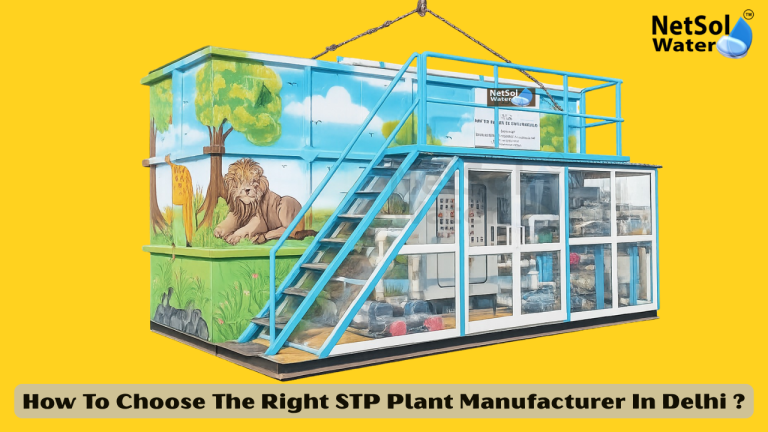
Most people do not think about sewage treatment until they absolutely have to. Maybe your housing society just received a notice from the pollution control board. Maybe your new commercial project requires an STP as part of the building approval. Or maybe you have been managing an aging plant that is constantly breaking down and you have finally decided enough is enough. In this blog we discuss about how to choose the right stp plant manufacturer in Delhi.
Whatever brought you here, you are now facing a decision that matters more than it might seem on the surface. Choosing the right Sewage Treatment Plant Manufacturer In Delhi is not just a procurement exercise. It is a decision that will affect your operations, your compliance status, your water reuse potential, and frankly your peace of mind for the next decade or more.
So let us walk through this properly.
Why This Decision Deserves More Attention Than Most People Give It
Delhi has hundreds of companies that will happily sell you an STP. The range is enormous, from small workshops assembling basic units to well-established manufacturers with proper engineering teams, ISO certifications, and years of installation experience.
Here is the reality though. A poorly chosen STP does not just underperform. It creates ongoing problems. Treated water that does not meet discharge norms. Breakdown calls every few months. Sludge management nightmares. And in the worst cases, legal notices from the Delhi Pollution Control Committee.
The investment in choosing well upfront pays dividends for years. And the cost of getting it wrong is much higher than the money you might save by going with the cheapest option.
That is why this guide exists.
Tips to Choose the Right Sewage Treatment Plant Manufacturer in Delhi
Start With Your Actual Requirements
Before you even begin talking to manufacturers, you need clarity on what you actually need. This sounds obvious, but many buyers skip this step and end up being sold something that does not fit their situation.
The first number you need is your daily sewage generation in kilolitres per day, or KLD. For residential buildings, a rough calculation is around 80 to 100 litres per person per day. For commercial complexes, hospitals, hotels, and institutions, the numbers vary significantly. Get this figure right before any conversation with a manufacturer, because this is the single most important parameter in sizing an STP.
What do you want to do with the treated water? If you simply need to meet discharge standards to avoid penalties, a conventional biological system may suffice. But if you want to reuse the treated water for flushing, gardening, cooling towers, or car washing, you will need higher output quality, which means a more advanced technology like MBR or SBR.
Check Whether the Manufacturer Actually Manufactures
This might sound strange, but it is genuinely important. In Delhi’s water treatment market, there is a category of companies that present themselves as manufacturers but are actually traders or assemblers. They procure components from various suppliers and put together a system. There is nothing necessarily wrong with this, but it creates real differences in accountability, customisation capability, and after-sales support.
A genuine Sewage Treatment Plant manufacturer in Delhi will have their own production facility, their own engineering and design team, and will be able to customise systems based on your project requirements rather than fitting you into whatever standard configuration they have in stock.
Ask to visit the manufacturing facility. Any serious manufacturer will welcome this and will be proud to show you their operations. A company that resists or deflects this request is telling you something important.
Verify Certifications and Technical Credentials
Certifications in this industry are not just paperwork. They reflect whether the manufacturer has invested in proper quality management systems, whether their processes meet defined standards, and whether they are serious about their work.
ISO Certification
ISO 9001 certification is a meaningful baseline. It tells you the manufacturer follows documented quality management processes. ISO certified manufacturers have gone through audits that verify their systems, not just their products.
CPHEEO and Pollution Control Compliance
The Central Public Health and Environmental Engineering Organisation has published manuals that define accepted standards for sewage treatment in India. A manufacturer who designs their systems in accordance with CPHEEO guidelines is working within a recognised technical framework, which matters for regulatory approvals and inspections.
CPCB Approved Designs
For certain categories of projects, having equipment that aligns with Central Pollution Control Board approved design guidelines is important for clearances. Ask your shortlisted manufacturers specifically about this.
Ask The Right Questions Before You Sign Anything
Once you have a shortlist of potential manufacturers, the conversation you have with them before signing a contract will tell you a lot. Here are the questions that actually matter and what good answers look like:
1) What technology do you recommend for my specific flow rate and output requirement, and why that technology over alternatives? A confident technical team will give you a clear and reasoned answer. Vague or purely sales-driven responses are a warning sign.
2) Can you show me a reference installation of similar scale and type that I can visit? Any manufacturer worth considering will have completed projects you can see. If they cannot point you to references, that is a red flag.
3) What does your warranty cover and for how long? Good manufacturers stand behind their equipment. Understand exactly what is covered, what is excluded, and what the process is if something goes wrong.
4) Who handles commissioning and how long does it typically take? Commissioning is the process of starting up and optimising the plant after installation. It requires skilled attention and should not be rushed.
5) What does your annual maintenance contract include? Running an STP requires regular servicing. Understand what is included, what parts are typically replaced, and what the cost implications are over the first five years.
6) How quickly can your service team reach our site if there is an emergency? In Delhi, a breakdown during peak usage is a serious problem. Knowing the manufacturer’s service response capability matters.
Evaluate Their Track Record in Delhi Specifically
Delhi’s wastewater characteristics, its regulatory environment, its ground conditions, and its space constraints are specific enough that experience in Delhi matters more than general experience elsewhere.
A manufacturer who has been installing and maintaining STPs in Delhi for several years will have learned the practical lessons that only come from working in this specific environment. They will know what the DPCC expects during inspections. They will know how summer heat and monsoon conditions affect plant performance here. They will have relationships with local service technicians and spare parts suppliers.
Ask how many projects they have completed in Delhi specifically. Ask about the types of projects, residential, commercial, industrial, institutional. Ask about projects that ran into challenges and how those challenges were resolved. Honest and detailed answers to these questions are a sign of genuine experience.
Understand The Full Cost & Purchase Price
This is where many buyers make a mistake that they regret for years. The purchase price of an STP is just one number. The real cost of ownership over ten years includes installation, commissioning, electricity consumption, chemical usage, routine maintenance, spare parts, emergency repairs, and sludge disposal.
A cheaper system often has higher operating costs because it is less energy efficient, requires more chemicals, produces more sludge, or demands more frequent attention. A more expensive but better-engineered system often works out significantly more economical over its lifetime.
When comparing proposals from different manufacturers, ask each one to provide a projected five-year operating cost estimate alongside their capital cost. This gives you a much more complete picture of what you are actually committing to.
About Commercial RO Plant
In a market as crowded as Delhi’s water treatment sector, Commercial RO Plant stands apart in ways that genuinely matter to clients.
Commercial RO Plant is an ISO certified RO Plant Manufacturer and Supplier operating across India, with deep roots and a strong track record in the Delhi NCR region. We have been designing, manufacturing, and installing water and sewage treatment solutions for residential complexes, commercial buildings, industrial units, hospitals, institutions, and infrastructure projects.
What makes us different is not just our certifications, though those matter. It is the combination of in-house engineering capability, transparent communication with clients, and a genuine commitment to after-sales support. We do not disappear after installation. We are the kind of partner who picks up the phone when you call.
Our technical team takes the time to understand your project properly before recommending a solution. We work with MBBR, SBR, MBR, SAFF, and ZLD-based systems and will match the right technology to your specific requirements rather than pushing a standard product that may not serve you well.
We have completed projects across Delhi and the wider NCR that we are proud to show you. When you work with us, you are not taking a chance on an unfamiliar name. You are working with a manufacturer whose installed plants are running successfully and whose clients are happy to share their experience.
Conclusion: Make The Right Call With Commercial RO Plant
Choosing a Sewage Treatment Plant Manufacturer in Delhi is a decision that deserves careful thought, honest conversations, and a willingness to look beyond the lowest price. The right manufacturer will make your STP project smooth, successful, and reliable for years to come. The wrong one will make it a source of ongoing frustration and expense.
You now have the framework to evaluate your options properly. Use it.
And when you are ready to talk to a manufacturer who combines ISO certified quality, real engineering expertise, proven Delhi experience, and genuine after-sales commitment, the conversation you want to have is with Commercial RO Plant.
Reach out to us today. Tell us about your project, your constraints, and your goals. We will give you an honest assessment and a solution that is designed to actually work, not just to win the contract. That is the Commercial RO Plant way, and it is why our clients keep coming back and referring others to us.