
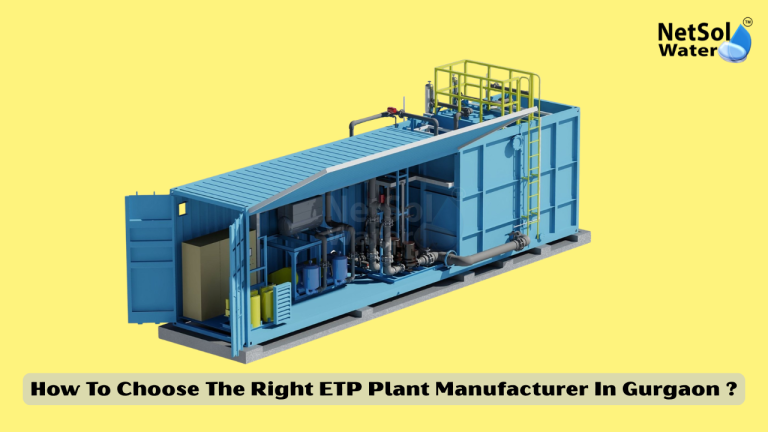
Choosing an effluent treatment plant manufacturer in Gurgaon is not a decision you should make based on the lowest quote. It is a decision that will affect your regulatory standing, your operational continuity, and your environmental liability for the next ten to fifteen years. Getting it wrong is expensive. Getting it right, on the other hand, gives you a system that runs reliably, keeps you compliant, and actually pays back over time through water savings and avoided penalties. In this blog we will discuss about the how to choose the right etp plant manufacturer in Gurgaon.
This page is a practical guide to making that decision well.
Start With Your Own Effluent Data, Not a Manufacturer’s Brochure
The first mistake most industries make is approaching manufacturers without knowing what their own wastewater actually contains. You end up listening to a sales pitch about technologies and capacities without any grounding in your specific situation.
Before you speak to any manufacturer, get your effluent tested at an accredited laboratory. The test report should cover pH, BOD, COD, TSS, TDS, oil and grease, heavy metals if relevant to your process, and any sector-specific parameters your pollution control board monitors.
When you walk into a manufacturer’s office with this data, the entire conversation changes. You are now evaluating whether they can solve a specific, documented problem rather than whether their brochure sounds convincing.
Any effluent treatment plant manufacturer in Gurgaon worth working with will ask for this data before quoting. If they do not, that tells you something important about how they approach engineering.
Understand What Your Consent Conditions Actually Require
Your Consent to Operate issued by the Haryana State Pollution Control Board specifies exactly what effluent quality you need to achieve before discharge. These are not general guidelines. They are legally binding discharge standards specific to your industry category, your location, and the type of water body or drain you are permitted to discharge into.
Read through your consent conditions before any manufacturer conversation. Identify the key discharge parameters and the limits specified for each. This is the performance target your ETP must consistently meet.
When evaluating manufacturers, ask them to show you specifically how their proposed design achieves each of those parameters. If they cannot walk you through that technically, they are not designing for your compliance requirement. They are proposing a generic system and hoping it works.
Evaluate Engineering Capability, Not Just Equipment Supply
There is a significant difference between a company that manufactures and engineers ETP systems and a company that assembles and supplies ETP equipment. The distinction matters more than most buyers realise.
An engineering-led manufacturer carries out effluent characterisation, process design, hydraulic calculations, civil design for tanks and structures, electrical and instrumentation design, and then manufactures or sources equipment to fit that design. Every component is selected based on what the system actually needs.
An equipment supplier, on the other hand, typically offers standard packages: a primary clarifier, a biological tank, a filter unit, assembled together in a configuration that resembles an ETP. It may work for simple, low-strength effluent. For anything complex, it often falls short.
When evaluating any effluent treatment plant manufacturer in Gurgaon, ask to see their process design documentation for a past project similar to yours. Ask who does their engineering. Ask whether civil design is done in-house or outsourced. The answers tell you quickly which category they fall into.
Check Their Track Record With Industries Like Yours
ETP design is sector-specific. A manufacturer who has built excellent systems for food processing plants is not automatically qualified to design an ETP for a pharmaceutical unit or a metal finishing facility. The effluent characteristics, the treatment chemistry, the regulatory parameters, and the operational challenges are fundamentally different across sectors.
Ask for project references specifically within your industry type. A good manufacturer will be able to name clients, describe the effluent challenge they faced, and explain what treatment approach was used. They should be comfortable with you calling those references directly to ask about system performance and after-sales support.
If references are vague, if the manufacturer deflects the question, or if every reference they offer is from a completely different industry than yours, factor that into your assessment.
Assess How They Handle the Post-Commissioning Phase
The commissioning date is when most problems begin, not when they end. A biological treatment system takes weeks to stabilise as the microbial population establishes itself. During this period, effluent quality may fluctuate and adjustments need to be made. Instrumentation needs calibration. Operators need hands-on training on actual operating conditions, not just a manual handover.
Ask any effluent treatment plant manufacturer in Gurgaon how long they remain on-site after commissioning. Ask what their stabilisation support process looks like.
Beyond stabilisation, ask about the long-term service arrangement. What is included in their annual maintenance contract? What is the response time commitment for breakdown calls? Do they stock spare parts for your system or do parts need to be ordered each time? These are not minor operational details. They determine how your plant performs over its entire working life.
Do Not Let Price Be the Deciding Factor
This point needs to be stated directly because it is the most common mistake industries make when evaluating ETP proposals.
An ETP plant is not a commodity where the cheapest option delivers the same outcome as a well-engineered one. The consequences of a plant that underperforms are real and quantifiable: pollution control board notices, legal fees, operational shutdowns, retrofitting costs, and potential reputational damage if environmental violations become public.
Compare proposals on a total cost of ownership basis. Factor in operating costs like power consumption, chemical dosing requirements, and maintenance. Factor in the quality of after-sales support. In this manufacturer’s track record and their ability to stand behind their work if something goes wrong.
A plant that costs fifteen percent more upfront but runs reliably for twelve years with minimal intervention is significantly cheaper than one that costs less initially but requires retrofitting within three years or generates non-compliance events that attract regulatory action.
Questions You Must Ask Every Manufacturer Before Deciding
Use this as a practical checklist during your evaluation conversations.
1) Will you conduct an effluent characterisation study before finalising the design?
2) Can you show me the specific process design for my effluent type, not a generic proposal?
3) What discharge quality will your system consistently achieve, and how do you guarantee it?
4) What is your experience with my specific industry sector?
5) Can I speak directly with two or three of your existing clients?
6) Who handles civil design, and is it done in-house?
7) What does your commissioning and stabilisation support process look like?
8) What are the ongoing operating costs for power and chemicals?
9) What is your response time for breakdown support after the warranty period?
10) Do you offer a long-term annual maintenance contract, and what does it cover?
A manufacturer who answers these questions confidently, specifically, and with supporting documentation is worth serious consideration. One who gives vague or evasive answers to any of them is telling you something important.
Red Flags to Watch Out For During Evaluation
There are specific patterns that should concern you when evaluating an effluent treatment plant manufacturer in Gurgaon.
A) A manufacturer who quotes without asking for your effluent data is not designing a system for your needs. They are proposing a standard package and hoping it fits.
B) A manufacturer who cannot explain their process design in plain language is either not doing proper engineering or does not understand it well enough to explain it. Either is a problem.
C) A manufacturer who pushes you toward a more expensive ZLD system when your consent conditions do not require ZLD may be optimising for project value rather than your best interest.
D) A manufacturer who has no documented after-sales support process or who becomes difficult to reach after contract signing is showing you exactly how they will behave when you need support most.
E) And a manufacturer who is unwilling to provide references from similar industries or who provides references that cannot be independently verified is not giving you confidence for good reason.
About Commercial RO Plant
Commercial RO Plant is an ISO certified manufacturer and supplier of ETP, STP, RO, and ZLD plants with over a decade of experience delivering water treatment solutions across industries throughout India. We have worked with pharmaceutical units, chemical plants, food processing facilities, textile manufacturers, automobile ancillary industries, and large commercial complexes, giving us direct working knowledge of the effluent challenges specific to each sector.
Every project we take on begins with a proper effluent characterisation study. We do not quote from a catalogue. Our process engineers design each system around the specific pollutant profile, the regulatory discharge standards applicable to the client, and the operational realities of their facility.
We handle the entire project in-house: process design, civil engineering, equipment manufacturing and procurement, electrical and instrumentation work, installation, commissioning, operator training, and long-term maintenance support. Our clients do not have to coordinate between multiple contractors. We own the outcome.
Our ISO certification reflects the quality management systems we follow across manufacturing, project execution, and service delivery. It is not a credential we earned once and filed away. It is the standard our teams are held to on every project.
As an effluent treatment plant manufacturer in Gurgaon and across the NCR region, Commercial RO Plant brings both the technical depth and the operational accountability that industries need from a long-term water treatment partner.
Conclusion
When we talk how to choose the right ETP plant manufacturer In gurgaon is fundamentally about choosing a partner who will take technical and operational responsibility for your compliance over the long term, not just deliver equipment and move on.
The evaluation process outlined in this page gives you the framework to make that choice with clarity and confidence. And if you are ready to have that conversation with a manufacturer who will engage with your actual requirement rather than pitch you a standard solution, Commercial RO Plant is ready to start with your effluent data and work from there.
Reach out today to speak with our engineering team.