
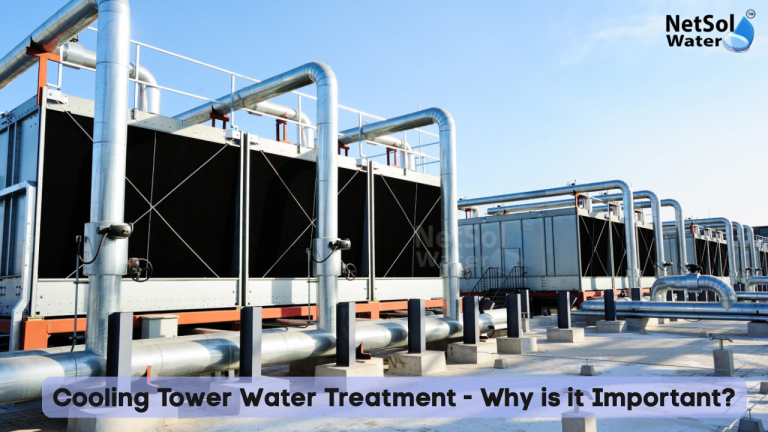
Let me ask you something simple. Have you ever walked past a large industrial facility and noticed those big tower-like structures with steam or mist coming out of the top? Those are cooling towers. And they are more important than most people realize. In this blog we will discuss about Cooling Tower Water Treatment – Why is it Important?
Almost every major industry depends on them. Power plants, refineries, cement factories, large office buildings with central air conditioning — all of them use cooling towers to get rid of excess heat. But here is the part that does not get talked about enough. The water inside those towers needs serious attention. Left untreated, it causes problems that shut down entire operations and cost crores to fix.
That is exactly what Cooling Tower Water Treatment is about. And in this article, we are going to break it all down in plain, simple terms.
Understand What a Cooling Tower Actually Does
Think of a cooling tower like a giant radiator. Your bike or car has a radiator that removes heat from the engine. A cooling tower does the same thing, just at a much larger scale.
Here is how it works in simple steps:
1) Hot water from an industrial process or air conditioning system enters the tower
2) That hot water gets sprayed over a fill media inside the tower
3) Air blows through the tower, either naturally or with fans
4) Some of the water evaporates, and that evaporation carries the heat away
5) The cooled water collects at the bottom and goes back to the process
6) The cycle repeats, over and over, all day long
That is it. Simple concept. But the water going through this cycle faces a lot of stress, and that is where the real challenge begins.
So Why Does the Water Need Treatment?
This is the most important question to answer before anything else.
When water evaporates inside a cooling tower, only the pure water leaves as vapor. Everything dissolved in it stays behind. Minerals, salts, chemicals — they all stay in the remaining water and keep building up with every cycle. On top of that, the tower is open to the air, which means dust, pollen, bacteria, and all kinds of airborne material enter the system constantly.
Over time, three major problems develop.
1) Scale
As minerals concentrate, they start sticking to the inside of pipes and heat exchangers as a hard, white deposit. This is called scale. It acts like an insulating blanket on heat transfer surfaces. The thicker it gets, the harder the system has to work to do the same job. Studies show that even a thin scale layer of just 1.5 mm can push energy consumption up by around 15%. That is a lot of wasted money every single month.
2) Corrosion
When the water chemistry goes out of balance, the water starts eating away at metal surfaces. Pipes, pumps, heat exchangers — all of them can corrode from the inside out. You cannot always see it happening. By the time you notice it, the damage is already serious. Corroded equipment fails suddenly, causes leaks, and forces emergency shutdowns.
3) Bacteria and Biological Growth
Warm water sitting in an open system is the perfect environment for bacteria and algae to grow. The most serious one is a bacterium called Legionella. It causes a severe form of pneumonia called Legionnaires disease. Outbreaks linked to poorly maintained cooling towers have been reported in cities across the world. It is not just an equipment problem. It is a genuine public health risk.
All three of these problems are completely preventable with proper Cooling Tower Water Treatment. That is the whole point.
What Does a Cooling Tower Water Treatment System Actually Include?
A treatment system is not a single machine you buy and plug in. It is a combination of different processes working together. Let us go through each one.
Step 1: Pre-Treatment of Makeup Water
Every time water evaporates from the tower, fresh water has to be added to replace it. This fresh water is called makeup water. Before it enters the tower, it needs to be cleaned and conditioned.
Depending on the source, makeup water can carry:
- Sand and suspended particles
- High levels of calcium and magnesium (hardness)
- High TDS (Total Dissolved Solids)
- Chlorine from municipal supply
Pre-treatment typically uses sand filters and water softeners to remove these impurities. In areas where the source water is very hard or has high TDS, an RO plant is used. An RO plant forces water through a fine membrane that blocks almost all dissolved salts and impurities. What comes out the other side is clean, low-TDS water that causes far less trouble inside the cooling tower.
Starting with clean makeup water is the smartest investment you can make in the long-term health of your cooling system.
Step 2: Filtration of Circulating Water
Even after pre-treatment, the water inside the tower picks up new contaminants during operation. Airborne dust settles into the basin. Biological matter accumulates. Particles break off from surfaces.
Side-stream filtration deals with this. A portion of the circulating water is continuously diverted through a filter and then returned clean to the system. Sand filters and multimedia filters are most commonly used for this purpose.
Without ongoing filtration, the basin turns into a muddy, bacteria-rich soup over time. That mud feeds biological growth and accelerates corrosion. Keeping the water physically clean is a basic but often neglected part of the job.
Step 3: Chemical Dosing
This is the heart of any Cooling Tower Water Treatment program. Chemicals are added to the circulating water on a continuous basis to keep the water chemistry in balance. There are four main types of chemicals used.
A) Scale Inhibitors
These chemicals prevent minerals from crystallizing and sticking to surfaces. They do not remove hardness from the water. They just change the behavior of the minerals so they stay dissolved and get flushed out instead of forming deposits. Phosphonates and polymer-based dispersants are among the most common ones used.
B) Corrosion Inhibitors
These form a very thin protective film on metal surfaces inside the system. That film acts as a barrier between the water and the metal. Different metals need different inhibitors. Copper components need one type. Steel and iron components need another. A good treatment program accounts for all the materials present in the system.
C) Biocides
Biocides kill bacteria, algae, and other microorganisms in the water. There are two main categories. Oxidizing biocides like chlorine and bromine work by chemically destroying microbial cells. Non-oxidizing biocides work differently and are used to target organisms that have become resistant to oxidizing treatments. Rotating between the two is a common practice to prevent resistance from building up.
D) pH Control Chemicals
The pH of the water needs to stay within a specific range, usually between 7 and 8.5. If it drops too low, corrosion speeds up dramatically. If it goes too high, scale forms much faster. Acid or alkali is dosed automatically to keep pH right where it needs to be.
Step 4: Blowdown Control
Remember how we said minerals concentrate over time as water evaporates? There is a measurement called Cycles of Concentration, or CoC, that tracks this. It tells you how concentrated the circulating water has become compared to the fresh makeup water.
For example, if the makeup water has 300 ppm of dissolved solids and the circulating water reaches 1500 ppm, you are at 5 cycles of concentration. Most systems are designed to operate between 3 and 6 cycles. Beyond that, the risk of scale and corrosion goes up sharply.
Blowdown is the practice of draining some of the concentrated water and replacing it with fresh makeup water. This brings the concentration back down to a safe level. Modern systems use automated blowdown controllers that monitor conductivity in real time and only open the blowdown valve when the concentration actually reaches the limit. This avoids wasting water through unnecessary or poorly timed manual blowdown.
Step 5: Monitoring and Automation
All of the above steps need to work together, and they need to respond quickly when something changes. That is what monitoring and automation systems do.
Sensors placed in the system continuously measure:
- pH levels
- Conductivity and TDS
- Water temperature
ORP, which indicates biocide effectiveness
Flow rates
When any reading goes outside the safe range, dosing pumps automatically adjust chemical delivery. Blowdown valves open and close based on real data. Alerts get sent to operators if something needs attention. A well-automated system runs largely on its own, with minimal manual intervention, and keeps the water chemistry stable around the clock.
What Happens When You Ignore Water Treatment?
Let us be direct about this. Companies that skip or cut corners on Cooling Tower Water Treatment pay for it eventually. Sometimes sooner than they expect.
Here is what typically happens:
1) Scale builds up quietly and energy bills creep up month after month
2) Corrosion causes a pipe or heat exchanger to fail suddenly during peak production
3) Biofilm coats the inside of the system and provides a hiding place for bacteria that biocides cannot easily reach
4) A Legionella outbreak puts workers at risk and invites serious legal and regulatory consequences
5) Emergency repairs and forced shutdowns cost far more than a year of proper treatment would have
The math is not complicated. Treating the water costs money. Not treating it costs far more.
How to Choose the Right Water Treatment Provider
Not every facility needs the same solution. Your cooling tower water treatment needs depend on your source water quality, your process temperatures, your system size, and what your equipment is made of. A good Water Treatment Provider understands all of this before recommending anything.
Here is what to look for when choosing one:
A) They start with a proper water analysis, not a standard package they sell to everyone
B) They have experience in your specific industry
C) They offer both chemicals and equipment, not just one or the other
D) They provide regular monitoring and follow-up support
E) They are certified and can document their quality standards
F) Their team is reachable when something goes wrong, not just during the sales process
A reliable Water Treatment Provider is not a vendor. They are a long-term technical partner for your facility.
About Commercial RO Plant
Commercial RO Plant is an ISO-certified manufacturer and supplier of water treatment systems based in India. We design and build RO plants, sewage treatment plants, effluent treatment plants, and complete cooling tower water treatment solutions for industrial and commercial clients across the country.
We have worked with clients across many cities throughout India. Our team understands the water quality challenges that are specific to different regions, and we design systems that actually account for those local conditions rather than offering a one-size-fits-all product.
Everything we manufacture is built in-house under strict quality controls. Every system is tested before it leaves our facility. And our relationship with clients does not end at delivery. We stay involved through installation, commissioning, operator training, and ongoing technical support.
We have helped hundreds of industrial facilities bring their cooling tower water treatment under control, reduce their water consumption, cut energy costs, and avoid the kind of expensive equipment failures that come from neglecting water quality.
Conclusion
Cooling tower water treatment is not a complicated concept. Untreated water causes scale, corrosion, and biological growth. Treated water keeps your system running clean, efficient, and safe. The technology to do it properly exists and is accessible. The only question is whether you choose to use it correctly.
If your cooling tower system is giving you trouble, if your energy bills are higher than they should be, if you are dealing with recurring equipment problems or just want to set things up right from the beginning, we would genuinely like to help.
Commercial RO Plant brings the right combination of quality equipment, technical knowledge, and hands-on support to make your water treatment program work. Not just on paper, but in your facility, every single day.
Get in touch with us today. Let us start with a water analysis and take it from there.