
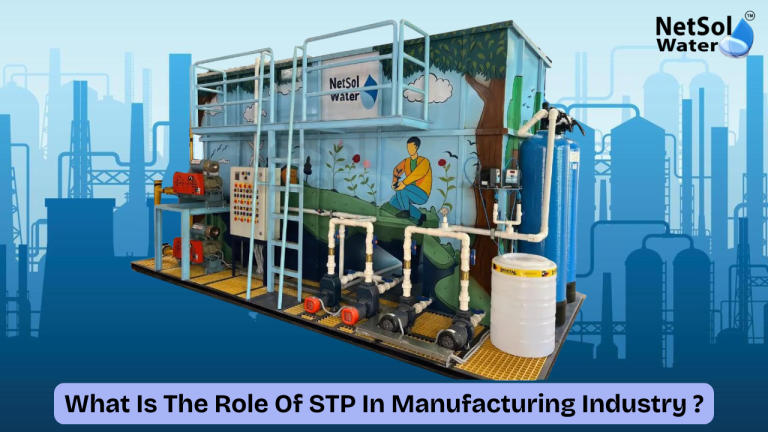
Although industries are very much important to economic growth, they also greatly contribute to environment’s contamination, specially through the release of industrial effluent. Role of STP In Manufacturing Industry is very much important for balancing environment while redefining wastewater composition, assuring follow-up to environment laws & standards, plus keeping ecosystems very protected. The serious role of STP in manufacturing industry, its processes, its advantages, plus the reasons they are important to healthy stable industrial operations are all covered in this concise discussion.
What is STP In Manufacturing Industry?
An advanced system created especially to handle wastewater produced by industrial processes is called an industrial sewage treatment plant. This is in contrast with residential community STPs, which deal with household sewage only. These facilities adopt cutting-edge treatment techniques to clean-up wastewater so that it may be re-purposed throughout the environment in an efficient manner. Commercial RO Plant is the best sewage treatment plant manufacturer in India at best affordable price and quality.
Why most of the Industrial Businesses Need STP In their Manufacturing Industry?
Large amounts of wastewater containing potentially hazardous materials are produced by industrial activities. Without receiving the appropriate care via STP In the manufacturing sector, these impurities may:
1) Damage the Water Bodies: Undesirable Harmful Substances can contaminate groundwater, rivers, or lakes, putting life in the water at risk.
2) Degrade the Quality of Land & its Soil: Harmful chemicals have the potential to harm soil health & lower agricultural output.
3) Raises Risks to Human Body & Living beings around: Untreated Sewage may have major concern for every living creature on the planet with such open waste.
4) Initiate Penalties for Regulation: The installation of well water treatment systems is essential for regulatory compliance as failure to comply with waste water treatment regulations may result in heavy penalties or legal problems.
Key Role of STP In Manufacturing Industry
A) Prevention & improvement: STP in the manufacturing sector/industry greatly lowers the harmful impacts of waste-water on the surrounding environment by cutting-down levels of pollutants.
B) Management of Resources: By recycling treated wastewater for application in industrial operations, freshwater resources may be exploited less often.
C) Administrative Compliance: By ensuring that businesses follow strict environment regulations, these facilities help to prevent legal issues.
Industrial Sewage Treatment Phases!
In order to guard equipment as well, Preliminary Therapy step forward at first to remove bigger & coarser material like plastic wrap, cloths, & sand.
First Treatment incorporates approaches such as flotation system becomes important for complete settling & then flushing-out all floating oil-based-lubricants.
Secondary treatment breaks down all contaminants & lowers BOD through the application of bio-logical procedures like activated-sludge or bio-filters.
In order to ensure that water satisfies high requirements, further treatment includes cutting-edge techniques including separation, reverse osmosis, plus UV disinfection to eliminate any remaining impurities.
Controlling Sludge Production- Sludge produced throughout the treatment process is processed & disposed of, frequently turning it into manure or some kind of energy.
The Manufacturing Industry’s Advantages of Installing STP Plant!
1) Safer Environment: Prevents infecting the environmental surroundings.
2) Economical: STP enables repurposing of waste-water which decreases the cost of buying of water at a greater price.
3) Opportunities for Greener Solutions: Encourages the application of circular water, supporting greener industrial methods.
4) Fame: Cleans a clients’ way of thinking as a reliable & environment-friendly Company.
What makes Industrial Effluents distinct from Sewage in the Manufacturing Sector?
Similar to household wastewater, industrial sewage usually comes from staff quarters, eateries, bathrooms, as well as administrative facilities near the manufacturing facilities. It also takes in oil-fats with food-grade wastes, trash wastes from different IT sectors, & also human-waste.
Conversely, industrial effluent is a consequence of industrial or manufacturing activities. Harsh contaminants like chemicals, metallic elements, oil and grease, plus elevated TDS are present. Compared to sewage, effluent treatment calls for more specialized equipment.
How STP Serves Important Sectors in the Manufacturing Sector
Industrial Sewage Treatment Plants are tailored to address sewage issues in several industries:
1) Textile Industry: Eliminates organic loads, color, & surfactants from sewage from staff colonies.
2) High levels of BODs, including oil-fats, alongside other organic sewages are handled by major food processing sectors.
3) Pharmaceutical plants: handle sewage containing antibiotics without interfering with microbiological activities.
4) Accurate level of Sewage handling in industrial regions is comparable to that of municipal civic loads, but that is on a greater scale.
Compliance with Indian Regulations Regarding Sewage Treatment in Manufacturing Industry
Important rules that STPs in Manufacturing Industry must follow by includes the EPA of 1986 alongside the CPCB’s Common Principles for Discharge:
A) NGT Wastewater Management Guidelines.
B) State-specific PCB regulations.
C) Serious fines, company shut warnings, or the loss of professional licenses might result from non-compliance.
How to Evaluate STP Efficiency in Industrial Environments
1) BOD or COD Removal Efficiency (in %) is one of the main pointer towards industrial STP performance.
2) Sludge Production Volume.
3) The amount of energy used accordingly to the treated water.
4) Downtime for maintenance.
5) Return On Investment for few years.
Difficulties in Managing STP in the Manufacturing Sector
Managing an effective industrial STP has a unique set of challenges:
a) Abrupt changes in load or shock loads.
b) Sludge handling with odor control.
c) Inadequate maintenance personnel or operators.
d) High cost of electricity for pumping along with distributing air.
Commercial RO Plant played an important part in present the Role of STP in Manufacturing Industry with Solutions
Commercial RO Plant, our premium product, provides:
1) High treatment efficiency for a variety of industrial effluents.
2) Energy-saving & economical operations;
3) Advanced modern world, pre-configured designs for more adaptability & simplicity during installation;
4) Commitment to regional & global environmental regulations.
Clients & consumers may regularly ask the following questions since our knowledge guarantees that sectors acquire superior wastewater treatment plant management:
How can STP in the manufacturing sector maintain balance to environmental laws?
In order to decrease environmental damage as well as prevent fines, these facilities utilize advanced therapies stages (preliminary, primary, secondary, along with tertiary) in the sewage treating process to decrease contaminants to levels that meet or surpass regulatory criteria.
Is it possible to recycle treated water from STPs in manufacturing industrial processes?
Indeed, cleaned water can be repurposed thereby implemented again in a many of the industrial operations which helps in lowering the dependence on other supplies thus saving money.
Conclusion
Models of STP in manufacturing Industry are becoming necessary for businesses trying for stability in the environment rather than a luxury. They guarantee efficient wastewater treatment, adherence to environmental regulations, & preserve of natural resources. Industries may embrace environmentally responsible practices without sacrificing productivity or revenue because to advancements like the Commercial RO Plant.